
Going Out of Network With a Dental PPO: How to Decide, Give Notice, and Keep Your Patients
How a dental office decides to go out of network with a PPO: run the numbers, read the contract, give notice and tell patients before the plan does.

The short answer: Going out of network with a dental PPO starts with your numbers: what share of patients and production the plan represents, its write-offs, and how many patients you could lose and still come out ahead. Then follow the contract’s termination clause. Send written notice. Tell patients before the plan does. Train the team on honest scripts. Track retention weekly.
This article is general information, not legal, financial or insurance advice. Contract terms and state laws vary. Review your contract and the decision with your attorney, and have your CPA check the financial model.
Free guide
“I Can’t Afford It.” Now What?
Patients will ask what it costs them. This free guide helps your team explain insurance, payment options and next steps.
Get the free guideThe conversation usually starts at the end of a long day.
The doctor looks at the write-off column, shakes their head, and says, “Why are we even taking this plan?”
Sometimes that’s the right question. Sometimes it’s frustration talking.
After more than 25 years in dental practice management, I treat going out of network as a spreadsheet first and a project second.
Patients rarely leave because of the decision. They leave because of how it was communicated. A letter they didn’t expect. A front desk that wasn’t ready for the question. A surprise bill after the cleaning.
That’s a systems problem. So let’s build the system.
When Going Out of Network Makes Sense (and When It Doesn’t)
There’s no single number that tells you to drop a plan. But there are signals worth paying attention to.
Signs it may be time:
- Write-offs are eating the margin on your highest-volume codes. If your most common procedures are reimbursed far below your full fees, the schedule can look busy while the practice loses ground.
- You’ve already tried to negotiate, and it went nowhere. If you haven’t, try negotiating first. Here’s how to negotiate higher PPO fees. Dropping a plan is the bigger move. Make sure the smaller one has been tried.
- The administrative burden is heavy. Downgrades, bundling, “least expensive alternative treatment” policies and audits cost time. The ADA points out that processing policies like these “can have an impact on your bottom line” (ADA, Terminating a Network Agreement).
- Your schedule is full and wait times are long. If you can’t get new patients in, freeing capacity can matter more than filling it with discounted visits.
Red flags that say slow down:
- The plan is a large share of your patients and your market has few other options for them.
- It’s an EPO or HMO-type plan with no out-of-network benefits. The ADA notes that patients can keep seeing you out of network only “if the plan is not an exclusive provider organization (EPO) plan which will only allow patients to see a network provider” (ADA PDF above). For those patients, leaving the network may mean leaving your practice. If you’re unclear on plan types, start with my PPO vs. HMO explainer.
- The schedule is already thin. Dropping a plan while you’re struggling to fill chairs is a hard road.
Run the Numbers First
Many offices skip this step. Pull these from your practice management system, plan by plan:
| What to pull | Why it matters |
|---|---|
| Patients of record and active patients on the plan | Who’s actually affected |
| The plan’s % of your active patients | How much is at stake |
| Production, collections and write-offs for the plan | What the plan really pays |
| Production mix (preventive vs. restorative vs. major) | Where the plan’s patients spend chair time |
| At least your top 10 to 15 codes: allowed fee vs. full fee | The gap per procedure (the ADA suggests looking at your top 25) |
| Downgrades and denials on those codes | What you actually collect, not what the fee schedule says |
In Dentistry IQ’s account of dropping PPOs, the author’s advice is to compare what you actually collect, not just the fee schedule, because downgrades and denials change the real picture.
If you’re running the fee-gap spreadsheet from the negotiation guide, use the same columns. That sheet feeds this one.
Break-Even Retention
Here’s the formula in words:
Break-even retention = the share of the plan’s patients you need to keep at your full fees (minus whatever patients now pay out of pocket because their out-of-network benefits are lower) to match the net collections you get from that plan today.
A hypothetical example, with made-up round numbers:
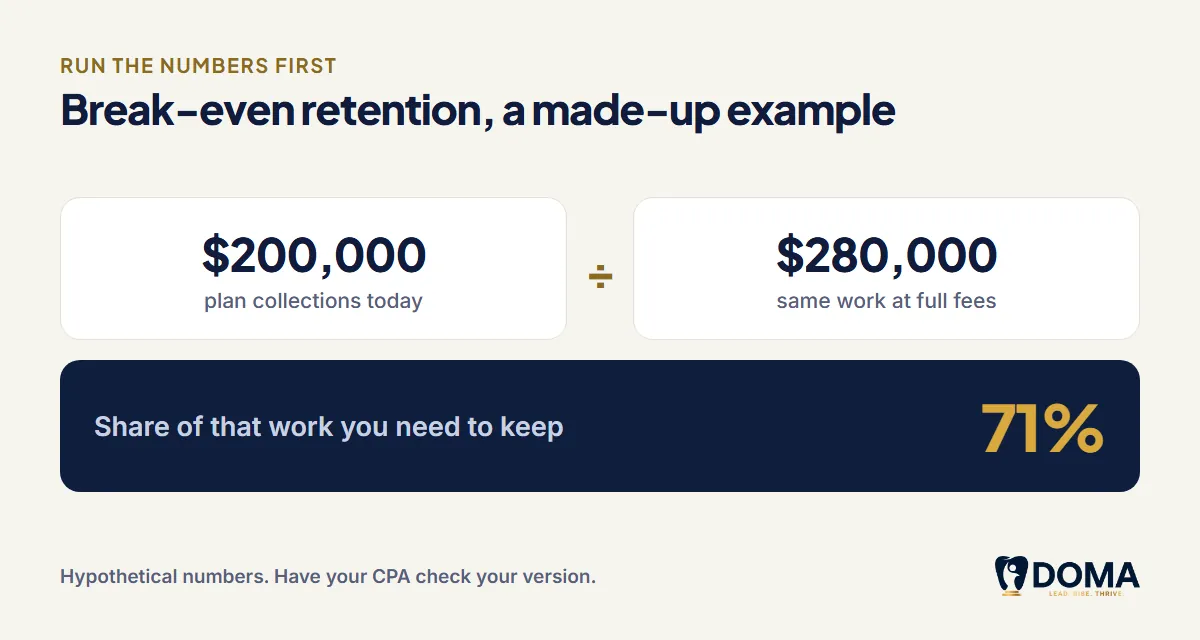
- The plan brings in $200,000 a year in collections at its contracted rates.
- Your full fees for that same work would be $280,000.
- If every patient stayed, you’d collect $280,000. To match $200,000, you need to keep about 71% of that work ($200,000 ÷ $280,000).
So in this hypothetical, if you keep more than roughly 71% of the plan’s patients (and their treatment), you come out ahead on collections. If you keep fewer, you don’t, unless you fill the freed time with other patients.
This example is simplified on purpose. Real life adds collection delays, patient-paid benefit gaps, and the value of chair time you free up. Have your CPA pressure-test your version.
One more caution. The Dentistry IQ author estimated that about 7% of their own patients were on the plan they dropped, as a worst case. That’s one dentist’s figure about one practice. Don’t use it as a benchmark. I haven’t found a reliable, sourced retention benchmark, and I wouldn’t trust one that ignores your market. Your numbers are the only ones that count.
Capacity and Replacement
Ask the next question too: if some patients leave, what fills that time?
- How much chair time and hygiene time does the plan’s patient base use today?
- Is your hygiene schedule booked out, or are there holes?
- What’s your new-patient marketing plan? The Dentistry IQ author treats this as part of the plan, not an afterthought.
Read the Contract Before You Give Notice
The ADA’s advice is simple: “Always have a copy of your signed contract. Ask for a copy if you do not have one!” (ADA PDF).
Here’s what to find in it:
- The termination clause and notice period. The ADA gives 30, 60 or 90 days’ advance written notice as examples. Inside Dentistry mentions a 6-month notice example. Yours is whatever your contract says.
- How notice must be delivered. The ADA recommends certified mail “to the proper address indicated by the plan,” and keeping a copy of the letter.
- Post-termination obligations. The ADA warns that “a contract may extend the dentist’s obligations beyond the termination date,” such as finishing care for patients under active treatment. Ask: Will you have to complete work in progress? How will you be paid for it? Will you still be bound by the contract price? (Also see the ADA’s What Every Dentist Should Know Before Signing a Dental Provider Contract.)
- Leased networks. The ADA explains that a plan may share its network with other carriers. Find out whether leaving one contract actually removes you from every network that leases it.
- All-products clauses. Some contracts tie participation in one product to others. The ADA’s Dental Insurance Contract Issues page covers these. Check whether your state limits them.
State laws on continuity of care and work in progress vary. Check your state and your contract.
Then review it with your attorney. I’m saying this plainly because it’s the step people want to skip. Don’t.
Build the Timeline
The ADA suggests that after you decide, “you may want to wait 6-12 months” to terminate, so your team can tell patients at their next recall visit. That’s a long runway, and it’s the gentlest one.
Other approaches are shorter. One consultant, Dr. Ryan Smith, lays out a sequence of training the team at about 90 days out, mailing the patient letter at about 60 days, and chairside conversations at about 30 days. That’s one consultant’s approach, not a rule.
Plan-year timing matters too. Check whether your patients’ plans run on a calendar year or a fiscal year. The AADOM author timed their change near open enrollment, when patients are already thinking about their benefits.
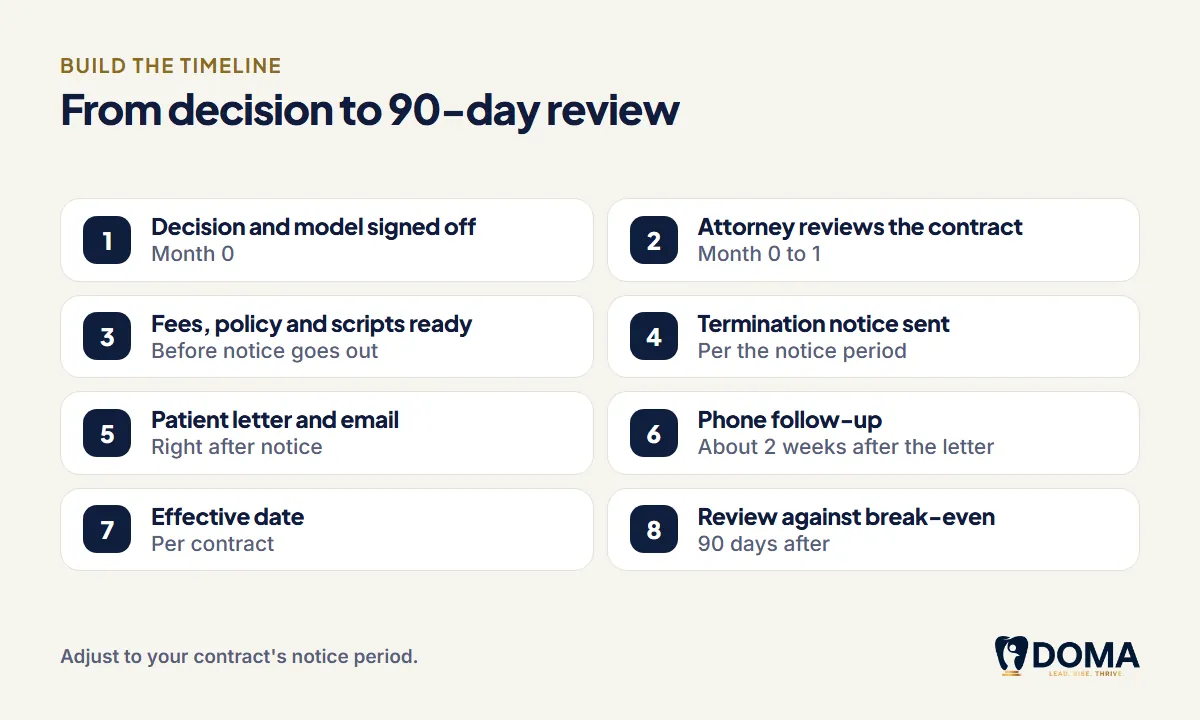
A sample timeline (adjust to your contract’s notice period):
| Step | When | Owner |
|---|---|---|
| Decision made, model signed off | Month 0 | Doctor/owner, office manager |
| Contract review with attorney | Month 0 to 1 | Office manager, attorney |
| Fee schedule, financial policy and scripts ready. Team trained | Before notice goes out | Office manager, insurance coordinator |
| Termination notice sent (certified mail, copy kept) | Notice period before the effective date | Office manager, doctor signs |
| Patient letter and email | Right after notice is sent | Office manager, front desk |
| Phone follow-up | About 2 weeks after the letter | Front desk |
| Effective date | Per contract | Insurance coordinator |
| 90-day review | 90 days after the effective date | Office manager, doctor |
Put it on the wall.
Tell Patients Before the Plan Does
The ADA says plans may send letters telling your patients you’re no longer in network and that they “may save money by visiting a network provider.” Some plans even print network dentists’ names and phone numbers on the patient’s EOB.
If the first time a patient hears about the change is from their insurance company, you’re already behind.
Use more than one channel:
- A letter and an email.
- A phone call about two weeks later (the AADOM author’s approach).
- A reminder before each upcoming appointment.
- The chairside conversation in hygiene.
Some states have rules about notifying patients when a provider leaves a network. Check your state and your contract.
The honesty rules:
- Don’t imply their benefits will be the same.
- Don’t promise coverage percentages.
- Don’t disparage the plan or the patient’s employer.
- Give written estimates before treatment.
Patients want clarity. The discomfort usually comes from us, not from them.
Scripts Your Team Can Use
Front desk (phone or in person): “Starting [date], we’ll be out of network with [plan]. You can still see us. Your plan may still pay out-of-network benefits, depending on your plan. We’ll give you an estimate before any treatment so there are no surprises. We’d love to keep caring for you. Want me to go over what that looks like for your next visit?”
“Why are you doing this?” “We want to keep giving you the time and care you’re used to, and that plan’s agreement no longer let us do that. It’s a business decision about the contract, not about you.”
Keep it factual. Don’t criticize the plan or the patient’s employer.
“Will it cost me more?” “It might, depending on your plan’s out-of-network benefits. Let us check your plan and give you an estimate in writing.”
Never quote a percentage before you’ve verified the plan. My insurance verification checklist and insurance determination letter help here.
“I need to stay in network.” “We understand. We’ll make it easy to transfer your records, and you’re always welcome back.”
What not to say:
- “Nothing changes.”
- “Your insurance will cover the same.”
- Anything implying the plan is acting illegally.
Role-play these before the letters go out. Every team member who answers a phone should be able to say them without reading.
Free guide
“I Can’t Afford It.” Now What?
Patients will ask what it costs them. This free guide helps your team explain insurance, payment options and next steps.
Get the free guideSet Your Out-of-Network Fee Schedule
Once you’re out of network, your full fee schedule is the one that counts. Build it from your own data:
- Your own costs: overhead, chair time, lab, supplies.
- Your own UCR analysis of your current full fees.
- Published fee data, such as the ADA Survey of Dental Fees or commercial fee data products, can be inputs.
Never use fees shared by other practices. That’s an antitrust problem, not a shortcut (more on that below).
The ADA’s Participating in a Plan page covers reporting your full fee on claims. If your fees are changing for existing patients, my dental fee increase letter gives you a starting template.
One more caution: don’t waive copays or deductibles to “match” in-network pricing without legal review. That can create insurance-fraud and contract problems. Balance billing and out-of-network write-off rules also vary by state and contract, so check yours.
Payments and Assignment of Benefits Once You’re Out of Network
This is where the billing workflow changes, and where surprises happen.
- The plan may pay the patient, not you. The ADA says that once you’re out of network, the plan “may not assign benefits directly to your office.” The same guide says “twenty-three states have passed legislation requiring that assignment of benefits be honored if authorized by the patient” (ADA, 2023). Laws change, so check your state.
- You may stop seeing EOBs. The ADA notes some plans no longer send EOB statements to non-contracted providers.
- Patients’ costs may go up. The ADA says plans may impose higher deductibles, lower annual maximums or higher coinsurance for out-of-network care.
Update your financial policy before the effective date:
- Decide whether you collect at the time of service or wait for assignment (where your state requires plans to honor it).
- Decide how you’ll help patients file claims, since many will be doing this for the first time.
- Put payment terms in writing. My patient payment agreement form is a good starting point.
- If patients have two plans, your coordination of benefits process matters even more.
For more on the billing side, see our dental insurance billing resources.
Alternatives to Offer Patients
Some patients will want an option that isn’t insurance. A few to consider:
- An in-house membership plan. A yearly fee for preventive care plus a discount on other treatment. You can hear two podcast conversations on the topic (partner content): Unlocking the Power of Dental Membership Plans with Paul Lowry and Revolutionizing Dental Membership Plans with Paul Lowry.
- A fee-for-service discount policy. The Dentistry IQ author describes a hybrid approach that offers a discount for fee-for-service patients.
- Financing for larger treatment plans.
States regulate membership plans and discount programs differently. Check your state’s rules with counsel before you launch one.
Who Does What: The Staff Workflow by Role
The fastest way for this to go wrong is everyone assuming someone else has it.
| Role | Owns |
|---|---|
| Doctor/owner | The decision. Signs the termination notice |
| Office manager | The model, the timeline, the contract notice, weekly tracking |
| Insurance coordinator | PMS flags on plan patients, fee schedule switch on the effective date, submitting claims as out of network, checking the plan’s directory |
| Front desk | Scripts, follow-up calls, appointment reminders |
| Hygiene/clinical | The chairside conversation at recall |
| Billing | Payments, assignment of benefits, patient statements |
After the Effective Date
The real tracking starts on the effective date.
- Get the termination and effective date confirmed in writing from the plan, and keep it with your copy of the notice.
- Check the plan’s directory. The ADA recommends visiting the plan’s website after termination takes effect to make sure you’ve been removed from the participating provider list, and submitting a written request at the time of termination asking to be removed from any participating provider list. If you’re still listed, contact the plan.
- Switch the fee schedule in your PMS for that plan’s patients.
- Track weekly (Dr. Smith’s list is a good one):
- cancellations from plan patients
- % of plan patients retained
- new-patient calls
- case acceptance
- collections per visit
- Review at 90 days against your break-even number.
If you’re below break-even at 90 days, look at where patients dropped off. Was it the letter, the phone call, the estimate, or the plan type? Fix that step.
Where AI Helps (and Where It Doesn’t)
AI can save you real time here. It can help you draft the patient letter, the email, the FAQ for your team, and role-play scripts. It can help you structure the worksheet.
Keep it PHI-safe. Don’t paste patient names, plan member IDs or anything from the chart into a public AI tool. Draft with placeholders.
And AI can’t read your contract for you or decide whether to drop a plan. That’s your attorney, your CPA, your doctor and you.
Antitrust: Decide Independently
The decision to drop a plan, and your fees, must be made independently. Don’t coordinate with competing practices on dropping a plan, on fees, or on timing. The Michigan Dental Association warns that informal conversations among dentists that lead to contract terminations “may be construed as an illegal agreement” (MDA). The ADA’s antitrust primer is worth a read too.
Talking about process with other managers (how you trained the team, how your letter was worded, how you tracked retention) is a different conversation from talking about fees or which plans you’re dropping. Stick to process.
Free guide
The Front Desk Cheat Sheet to Dental Plan Types
PPO, DHMO, indemnity, Medicare Advantage and Medicaid plans explained, with the questions to ask when you verify benefits.
Get the free guideYour Going-Out-of-Network Checklist
- ☐ Run the model per plan (patient %, production mix, write-offs, top codes, break-even retention).
- ☐ Try a fee negotiation first, if you haven’t already (how to negotiate higher PPO fees).
- ☐ Get the signed contract. Note the notice period, delivery method, post-termination terms and leased networks. Attorney review.
- ☐ Set the effective date (plan year, recall cycle).
- ☐ Set the out-of-network fee schedule (your own data only).
- ☐ Update the financial policy (payment at time of service, assignment of benefits per state law, claims help).
- ☐ Decide on alternatives (membership plan, financing).
- ☐ Write the patient letter, email and scripts. Train the team and role-play.
- ☐ Send the termination notice (certified mail, keep a copy). Then send patient letters promptly.
- ☐ Phone follow-up about 2 weeks after the letter.
- ☐ Flag plan patients in the PMS. Set a pre-appointment reminder.
- ☐ On the effective date: switch the fee schedule. Confirm termination in writing. Check the directory.
- ☐ Track weekly. Review at 90 days.
Frequently Asked Questions
Should my dental practice go out of network with a PPO?
Only if your own numbers support it. Pull the plan’s share of active patients, production mix, write-offs and allowed vs. full fees on your top codes, then calculate the share of patients you’d need to keep at full fee to break even. Try negotiating first, and review the decision with your attorney and CPA.
How much notice do I have to give to drop a dental PPO?
Whatever your signed contract says. The ADA gives 30, 60 or 90 days’ advance written notice as examples, and some contracts require longer. Read the termination clause, send notice the way the contract specifies (the ADA recommends certified mail to the plan’s stated address), and keep a copy.
Will patients still have coverage if we’re out of network?
It depends on their plan. Many PPO plans pay some out-of-network benefits, but the ADA notes plans may apply higher deductibles, lower maximums or higher coinsurance. EPO and HMO-type plans may pay nothing out of network. Verify each patient’s plan and give a written estimate before treatment.
Will the insurance company pay the office or the patient once we’re out of network?
It may pay the patient. The ADA says out-of-network offices may lose direct assignment of benefits, though its 2023 guide notes 23 states require plans to honor assignment if the patient authorizes it. Check your state’s law, then update your financial policy on when you collect.
What should we say to patients when we drop their insurance?
Tell them before the plan does, in writing and by phone. Say they can still see you, their plan may still pay out-of-network benefits depending on the plan, and you’ll give a written estimate before treatment. Don’t promise the same coverage, quote percentages before verifying, or criticize the plan.
How do we set fees after going out of network?
Base your fee schedule on your own costs and your own UCR analysis of your full fees. Published fee survey data can be an input. Never use fee information shared by other practices, because that raises antitrust concerns. Report your full fee on claims, and don’t waive copays or deductibles without legal review.
Is an in-house membership plan a good alternative to a PPO?
It can be for some patients, especially those who mainly want preventive care. A membership plan usually charges a yearly fee for preventive visits plus a discount on other treatment. States regulate membership and discount plans differently, so check your state’s rules with counsel before you launch one.
How do we track whether going out of network worked?
Track weekly from the effective date: cancellations from plan patients, the share of plan patients retained, new-patient calls, case acceptance and collections per visit. At 90 days, compare your results to your break-even retention number. If you’re short, find the step where patients dropped off and fix it.
The Bottom Line
Decide on your numbers, then run the change like the project it is: contract, timeline, scripts, workflow, tracking.
That’s where I’d start.
Get ready for the estimate conversations. Going out of network means more conversations about what patients will owe. Our free ebook, Maximizing Dental Insurance Benefits, helps your team explain patient responsibility with more confidence.
Draft your letter and scripts with AI, without patient data. AI Ready Certification teaches dental office managers to use AI safely and practically: 6 modules, 36 lessons, self-paced, $297, with a 14-day promise.
Gone out of network with a plan? Share what worked with 27,000+ office managers in our network: how you trained the team, how you worded the letter, how you tracked retention. Join the Dental Office Managers Community or visit our community page. Please keep it to process: don’t share fee amounts, rates, or which plans you or other offices are dropping. Antitrust rules apply.
Sources
- ADA, “Terminating a Network Agreement” (PDF)
- ADA, “What Every Dentist Should Know Before Signing a Dental Provider Contract” (PDF)
- ADA, “Participating in a Plan”
- ADA, “Dental Insurance Contract Issues”
- AADOM, “6 Steps to Successfully Dropping Your Favorite PPO”
- Dentistry IQ, “How dentists can successfully drop PPOs”
- Inside Dentistry, “Declare Independence From PPOs”
- Ryan Smith, DDS (consultant), out-of-network patient letter
- ADA antitrust primer (PDF)
- Michigan Dental Association, “Yes, Dentists (and the MDA) Are Subject to Antitrust Law”
This article is general information, not legal, financial or insurance advice. Review your contract with your attorney and your financial model with your CPA.
Free guide
Maximizing Dental Insurance Benefits
Going through fees and coverage with patients? Get DOMA’s free guide to estimates, secondary plans and cleaner claims.
Get the free guideAI Ready Certification
Use AI safely in the office
The Dental AI Standard’s AI Ready Certification is $297, with 6 modules and 36 lessons. It’s self-paced and comes with a 14-day promise.
See the certificationDOMA community
How did you train the team for the change?
Share your process with 27,000+ dental office managers in the Dental Office Managers Community (no fees, rates or plan names, please).
Join the communityFree for dental office managers
Get the Free Starter Kit
4 ebooks and 2 course previews from Kyle Summerford, plus free membership and a combined DOMA audience of 50,000+ dental professionals. No credit card.


