
The Dental Patient Collections Checklist: How to Get Patient Balances Paid
A dental patient collections checklist: written estimates, collecting at checkout, a follow-up calendar, payment plans and the 3 numbers to track.

The short answer: Most patient balances get collected or lost before the patient leaves. Give a written estimate before treatment, collect the patient portion at checkout, send statements on a set schedule, follow up by text and phone on fixed days, offer a written payment plan, and track patient A/R aging, days to collect, and collection rate.
Why Patient Balances Slip
I’ve been in this work for 25 years, and I can usually tell you why a patient A/R report looks the way it does before I open it. Somebody skipped the written estimate. Somebody told the patient, “We’ll bill you after insurance pays.” And the only follow-up was another statement.
Free guide
Production vs. Collection: The Gap That’s Costing You
See where collections leak between production and the bank. Free guide.
Get the free guide“We’ll bill you later” sounds helpful. It also means the patient leaves owing money you have not asked for. As AADOM put it on its November 12, 2026 webinar page, “Sending a statement isn’t follow-up, it’s hoping.” I agree with that line. A statement tells the patient what they owe. Follow-up is the text, the phone call, and the written next step.
You can tighten this in a week with a written process the front desk can run on a Tuesday afternoon.
Before the Visit: Estimates and the Financial Policy
Verify benefits before the appointment, not at the chair. Our insurance verification checklist walks through that process.
Then give a written estimate of the patient portion before treatment starts. Walk through it with the patient, and have them sign that they received it. “Written” can be a printed estimate, a portal message, or the form your software already produces. The number has to be in front of the patient before the work is done.
State your financial policy in plain language: what is due at the visit, how you handle what insurance does not pay, whether you offer payment plans, and what you do if a balance goes unpaid. Give it at the first visit, and again when treatment is presented.
If you keep a card on file, get written consent first, and only charge what that consent allows. Card-on-file and surcharge rules vary by state and by card network, so check yours. If you store card data, you also have to meet card-data security rules (PCI DSS). The ADA’s overdue-accounts guidance covers this.
If your office offers an in-house membership plan, present it when you present treatment as one more way to handle the patient portion, then use the same checkout and follow-up rules you use for everyone else.
At Checkout: Collect the Estimated Patient Portion
Collect the estimated patient portion before the patient leaves.
When someone says, “Can you just bill me?”, you need a script and a policy, not a gut decision at a busy counter. Here is a hypothetical script you can adapt:
“I can help you with that. We collect the estimated patient portion today, based on the written estimate we already went over. We can take a card or another form of payment now, or we can set up a written payment plan before you go. Which works better for you?”
Say the portion as a fact, then ask how they would like to pay, not whether they would like to pay.
Write down who is allowed to waive or discount a balance. In most offices, that should be the dentist or the owner, not whoever is at the front desk at 5:15. Document every exception. This is the same control we talk about in how to prevent embezzlement in a dental office: discounts and write-offs without a named approver are how money walks away, even when nobody means harm.
After Insurance Pays: Post It, Then Bill the Balance
Post the EOB or ERA as soon as it arrives. The same week the insurance payment is posted, send the patient any remaining balance. The ADA’s overdue-accounts page says to send that statement immediately when a balance remains after the benefit is paid. If estimates are often off, tighten the estimate process rather than letting leftover balances sit.
Refund credit balances promptly. Credits belong to the patient, and they distort your A/R if you leave them sitting.
A clean ledger makes all of this easier. Our patient payment ledger guide is there if your posting is messy.
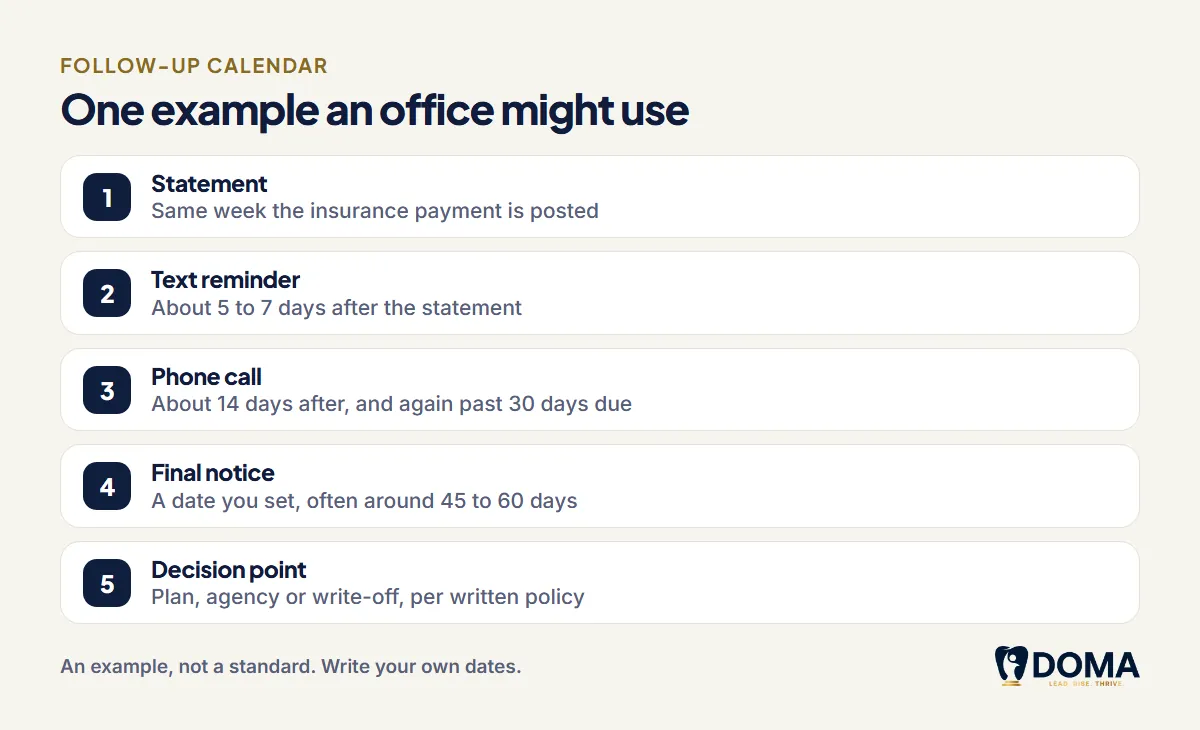
The Follow-Up Calendar (an example, not a standard)
Set the days yourself. Write them down. Then keep them.
The ADA generally recommends weekly statements for every patient with a balance, including balances left after insurance pays, and each statement should include a due date. Accounts more than 30 days past due get a phone call, not just another piece of mail.
Here is one hypothetical example of a follow-up calendar an office might use. It is not a standard, and it is not a legal requirement. Use it as a starting point, then write your own dates.
| Step | Example timing | What happens |
|---|---|---|
| Statement | Same week the insurance payment is posted, or on your weekly statement run | Clear balance, due date, payment options, and a way to reach billing |
| Text reminder | About 5 to 7 days after the statement | Short, friendly reminder with a payment link if you use one |
| Phone call | About 14 days after the statement, and again if the account is more than 30 days past due | A real conversation: pay now, set a plan, or resolve a dispute |
| Final notice | A date you set, often around 45 to 60 days | Written notice of the next step in your policy, with a deadline |
| Decision point | After the deadline in the final notice | Payment plan, collection-agency referral, or write-off, per your written policy, approved by the dentist or owner |
Document every contact in the account. If a patient promises a date, write the date and follow it.
Payment Plans: Put It in Writing
If the patient cannot pay the balance in full, offer a written payment plan before they leave, or as soon as the remaining balance is known.
A solid plan includes:
- The responsible party’s name and the treatment or dates it covers
- The total balance, any deposit, the payment amount, and the due dates
- Whether auto-pay is authorized, and on which card or account
- What happens if a payment is missed (when you call, when the plan is void, when the balance becomes due)
- Who approved the plan
Have the patient sign it. Keep a copy in the account. Our patient payment agreement form is a starting point if you need one.
Use auto-pay when the patient agrees, so a forgotten month does not turn into three. If a payment is missed, follow the rule you already wrote.
For larger treatment, third-party patient financing can be an option alongside an in-office plan. Present it as a choice, and stay inside whatever your office has approved.
Tools to consider
DayDream Dental
DayDream handles insurance verification, payment posting and patient billing. DOMA members get 25% off their first three months of service. DOMA partner. DOMA may receive compensation, offer details are set by the partner.
See the DayDream offerTools to consider
Cherry
Cherry offers patient financing and payment plans so patients can split out-of-pocket dental treatment into weekly or monthly payments. The practice is paid up front, and Cherry handles repayment with the patient. DOMA partner. DOMA may receive compensation, offer details are set by the partner.
See the Cherry offerWhen to Stop: Collection Agency or Write-Off
Every office needs a written rule for when an unpaid balance goes to a collection agency, and when it is written off. “We’ll see” is not a policy.
The dentist or the owner should approve that step. Before you send anything out, confirm the balance is real, the estimate and EOB are posted correctly, follow-up actually happened, and whether the patient is in active treatment.
This is not legal advice. Collection, late-fee and credit-reporting rules vary. Check your state.
Do not threaten a step you are not prepared to take. If your policy includes a final notice, send it, date it, and follow through the way the policy is written.
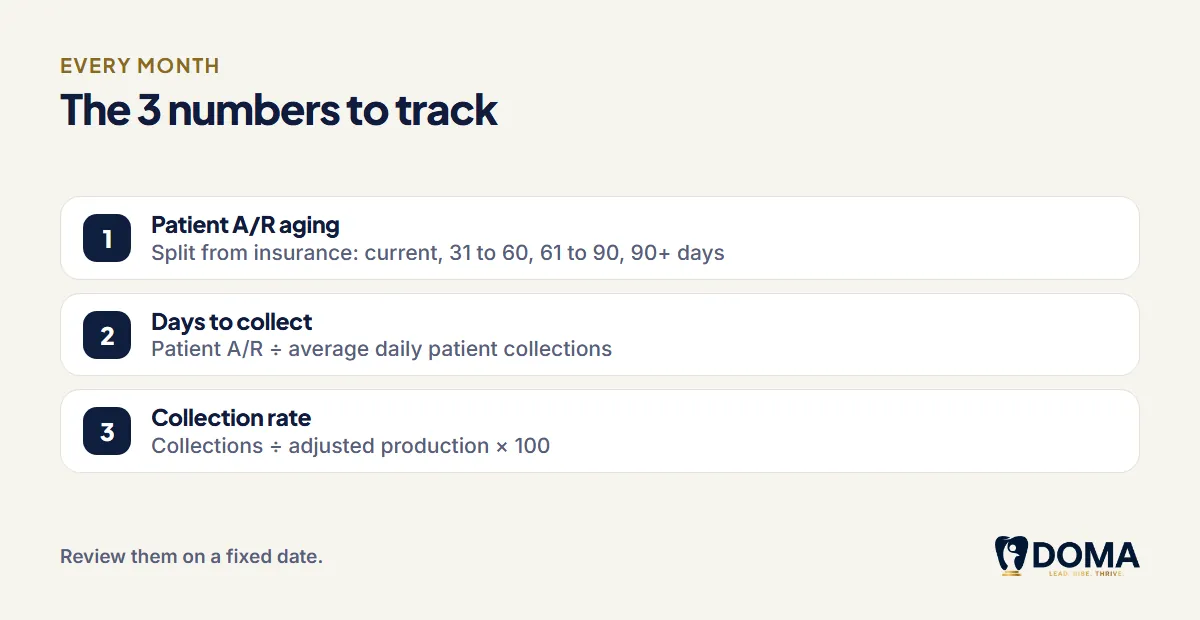
The 3 Numbers to Track
You need three numbers, reviewed on a fixed date each month.
Patient A/R aging. Split patient balances from insurance balances. Work the buckets: current (0 to 30 days), 31 to 60, 61 to 90, and 90+ days. If the report makes your stomach drop, start with reading your aging report without panicking.
Days to collect. This is how long, on average, balances sit before they are paid. A common calculation is outstanding patient A/R divided by average daily patient collections for the same period. Your software may label this days sales outstanding, and it may use business days or calendar days, so write down the definition you use and keep it consistent. I am not giving a target number to copy. I have not seen one association benchmark I would ask every office to use. Watch the trend, and track patient A/R on its own.
Collection rate. Formula: collections divided by adjusted production, times 100. Adjusted production is what is collectible after contractual write-offs and other adjustments, not full-fee gross production. The ADA’s Key Performance Indicators page says that if a practice is not collecting 98% of billable or adjusted production, its policies and scripts may need to be adjusted. That figure is for overall collections, insurance and patient together, so still pull patient A/R out and look at it separately. More on the formula in production vs. collection: the gap that’s costing you.
Free guide
Production vs. Collection: The Gap That’s Costing You
See where collections leak between production and the bank. Free guide.
Get the free guideSelf-Check: Where Is Your Office Today?
Use this as an honest snapshot. Pick the column that sounds like your office right now, then pick one row to move this month.
| Process | Manual and reactive | Written and reviewed monthly |
|---|---|---|
| Estimates | Estimates are verbal, or only printed if the patient asks | Every treatment plan gets a written estimate before work starts, and you spot-check estimate accuracy |
| Checkout | “Can you just bill me?” usually gets a yes | The estimated patient portion is collected at the visit, and only a named person can waive or discount |
| Follow-up | Statements go out when someone remembers, with no text or call schedule | Statements, texts, and calls go out on a written calendar, and every contact is documented |
| Payment plans | Handshake plans, no auto-pay, and missed payments sit | Written agreements, auto-pay when the patient agrees, and a written rule for a missed payment |
| The 3 numbers | You look at total A/R when it feels high | Patient A/R aging, days to collect, and collection rate are reviewed on a fixed date each month |
Printable Patient Collections Checklist
Print this, assign an owner, and run it for 30 days.
Before the visit
- ☐ Verify benefits before the appointment.
- ☐ Give a written estimate of the patient portion and have the patient sign that they received it.
- ☐ Review the financial policy, including payment plans and what happens if a balance goes unpaid.
- ☐ If you keep a card on file, get written consent first.
At checkout
- ☐ Collect the estimated patient portion before the patient leaves.
- ☐ Use the office script when a patient asks to be billed later.
- ☐ If the balance cannot be paid in full, set up a written payment plan before the patient leaves.
- ☐ Only a named person (usually the dentist or owner) may waive or discount a balance, and every exception is documented.
After insurance pays
- ☐ Post the EOB or ERA promptly.
- ☐ Send any remaining patient balance the same week.
- ☐ Refund credit balances promptly.
Follow-up
- ☐ Run statements on the written schedule (the ADA generally recommends weekly, with a due date on each statement).
- ☐ Send the text reminder and make the phone calls on the days you wrote down.
- ☐ Document every contact, promise to pay, and missed payment in the account.
- ☐ Send the final notice on the date in your policy, then take the next step the policy names.
Each month
- ☐ Review patient A/R aging (separate from insurance), days to collect, and collection rate on a fixed date.
- ☐ Pick one row on the self-check to improve this month.
Frequently Asked Questions
How do dental offices collect patient balances?
Dental offices collect patient balances with a written estimate before treatment, the estimated patient portion collected at checkout, insurance posted promptly, and any remaining balance sent the same week. Follow up by text and phone on a written schedule, offer a written payment plan when needed, and track patient A/R aging, days to collect, and collection rate.
When should a dental office collect the patient portion?
Collect the estimated patient portion at the visit, based on a written estimate. Don’t wait until insurance pays to ask for it. The ADA’s overdue-accounts guidance is to collect the anticipated patient amount at the time of service. If a balance remains after the EOB or ERA is posted, send that statement the same week.
How often should a dental office send patient statements?
Set a written schedule and keep it. The ADA generally recommends weekly statements for every patient with a balance, including balances left after insurance pays, and each statement should include a due date. Your office can choose a different cadence. Statements alone are not follow-up. Pair them with texts and phone calls on fixed days.
What is a good dental payment plan policy?
A good policy is written, signed, and specific. It names the total, the deposit, the payment amount and due dates, whether auto-pay is used, and what happens if a payment is missed. Only a named person can approve exceptions. Third-party financing can be an option for larger treatment. Keep a signed copy in the account.
What KPIs measure dental patient collections?
Three numbers tell you if the front desk is collecting: patient A/R aging (balances in current, 31 to 60, 61 to 90, and 90+ day buckets), days to collect, and collection rate. Collection rate is collections divided by adjusted production, times 100. Review all three on a fixed date each month, and track patient A/R separately from insurance.
Keep Going
Start with the free guide to reading your aging report without panicking. It shows you how to work the 30, 60, and 90-day buckets once the balances are on the report.
Share your follow-up schedule with 27,000+ managers in the free Dental Office Managers Community on Facebook.
Browse more partner tools and offers when you are ready to compare billing and financing options.
This article is front-office workflow, not legal advice. Collection, late-fee, credit-reporting, card-on-file, and surcharge rules vary. Check your state and your card network.
Sources: American Dental Association, “Overdue Accounts,” and “Measuring Success” (Key Performance Indicators), both on ada.org. The statement line in the opening is from AADOM’s November 12, 2026 webinar page for “From Chasing Balances to Collecting on Autopilot: The 5 Stages of Patient Billing Maturity.”
Free guide
Reading Your Aging Report Without Panicking
Work the 30, 60 and 90-day buckets once the balances are on the report. Free guide.
Get the free guideDOMA community
What’s your follow-up schedule after a statement goes out?
Share it with 27,000+ dental office managers in the Dental Office Managers Community (no patient details, please).
Join the communityFree for dental office managers
Get the Free Starter Kit
4 ebooks and 2 course previews from Kyle Summerford, plus free membership and a combined DOMA audience of 50,000+ dental professionals. No credit card.


