
How to Negotiate Higher In-Network Fees With Dental Insurance Carriers
How dental office managers negotiate higher PPO fees: the data to pull, the letter and call script, follow-up dates and the walk-away number.

The short answer: To negotiate higher in-network fees, build a case from your own data: your highest-revenue procedure codes, how often you bill them, the current allowed amounts, your desired fees and your costs. Find the carrier’s provider relations representative. Ask in writing for specific increases. Get every agreement in writing, and check your next EOBs. Negotiate only for your own practice, never with other offices.
Ask a room of office managers when their PPO fee schedules last went up, and you’ll get a lot of shrugs.
Free guide
The 10 Reports Every Dental Practice Should Run Every Month
The monthly side of your numbers on one page. Free checklist.
Get the free guideFive years. Seven. “I’m not sure we ever asked.”
That last answer is the honest one in a lot of practices. Costs went up. Payroll went up. Supplies and lab went up. The fee schedule sat in a drawer.
After more than 25 years in dental practice management, I can tell you carriers respond to data and persistence. Venting on the phone doesn’t move a fee schedule. A clean packet, a specific ask and a follow-up date sometimes does.
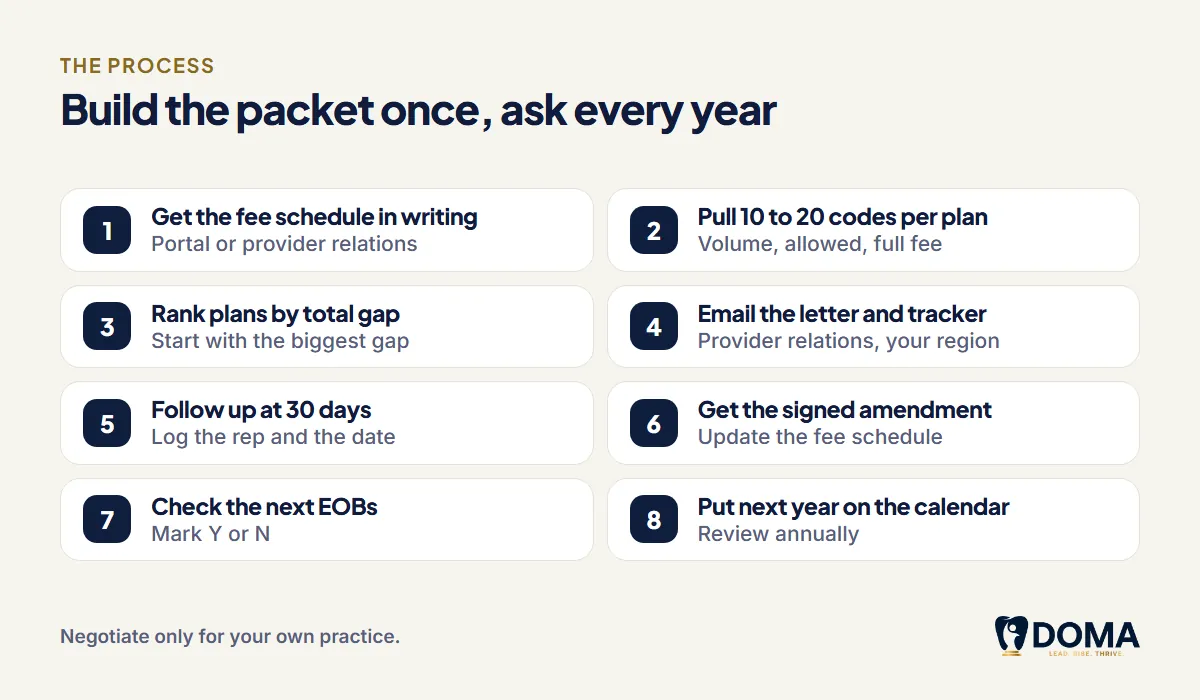
So build the packet once. Ask every year. Track it like any other system.
And know your walk-away number before you ask.
This article is general education, not legal or financial advice. Contract terms and state laws vary. Review your provider contract and any amendment with an attorney, and build your financial model with your CPA.
One rule up front: negotiate only for your own practice. Never share or compare fee schedules, rates, strategy or plans to drop a carrier with competing offices. That’s antitrust law, and it applies to Facebook groups, study clubs and our own community too.
A quick note on what this post isn’t. If you’re looking to raise the fees you charge patients, that’s a different job, and the fee increase letter guide covers it. This post is about asking an insurance carrier to raise what it pays you as an in-network provider.
Before You Start: Negotiate Alone
Antitrust comes first.
The ADA’s Fee Schedule Negotiation Guide is plain about it: “These negotiations should be conducted individually, between only you and your plan, and not with or on behalf of other dentists. Do not discuss fee schedules or other contract points with your colleagues or peers.”
Antitrust: what not to do
- Negotiate only for your own practice.
- Don’t share or compare fee schedules, allowed amounts, requested increases, negotiation strategy, or plans to terminate a contract with competing practices. That includes Facebook groups, study clubs, and the DOMA community.
- Don’t use fee data you got from a competing office.
- Don’t coordinate with other practices about dropping a carrier, or threaten it together. The Michigan Dental Association gives the example of a letter stating that specified dentists will terminate if fees aren’t raised, and treats that as price-fixing.
- Fully integrated group practices can be treated differently (MDA). If that’s you, check with counsel.
- The ADA’s antitrust primer is worth a read for the owner and the manager.
Talking about process with other managers is fine: who you contacted, how you organized your packet, how long it took to hear back. Talking about numbers with competing offices is not.
Your fee schedule is also often marked confidential in the contract itself. Check yours before you share it with anyone, even a consultant.
Gather Your Data
You can’t ask for a raise you can’t explain. This is where most of the work lives.
Your Fee Schedule Analysis
Start by getting each plan’s current fee schedule in writing, from the provider portal or from provider relations. Don’t rely on what the software says the plan pays. Software fee schedules drift.
Then, for each plan, pull the procedure codes that generate the most total revenue. The ADA guide lists the data you need for each one:
- How often each procedure is reported
- The current allowed amount (your current discounted fee)
- How much each code contributes to your overall practice revenue
- Your desired fee for each code
I’d add your full office fee next to the allowed amount. Ten to twenty codes per plan is usually enough to tell the story. For most offices, that list will be heavy on hygiene, exams, radiographs and a few restorative and crown codes.
If you already run a monthly write-off or adjustment report, you’re halfway there. It’s one of the 10 reports every dental practice should run monthly, and it shows you which plans cost you the most.
Reimbursement vs. Cost
The ADA also lists “costs associated with operating your business” as part of your numbers.
Work with your CPA to estimate your cost per procedure or per chair hour. The goal is to find the codes where a plan’s allowed amount is close to, or below, what it costs you to deliver the service.
That’s a different conversation than “we’d like more money.” It’s “this code doesn’t cover our cost to provide it.”
UCR and Market Benchmarks
Your own full fees are your starting UCR. If your office fees haven’t been reviewed in a while, fix that first. A negotiation built on stale office fees starts weak.
Also important: the ADA says “it is very important to report your full fee on the claim form,” because “payers may use the charges you submit to determine maximum-allowable fees.” If your team has been submitting the discounted fee, that habit is quietly working against you.
For outside benchmarks, the ADA guide points to its Survey of Dental Fees. There are also commercial fee-data products and vendor “market rate” tools, some built on carrier price-transparency files. Those are licensed vendor products. Evaluate them like any other purchase.
What you never use: fee data from a competing office.
Your Leverage
The ADA calls these your “strengths,” and they belong in your letter:
- Number of dentists in your area. The ADA notes that dentists in areas with fewer dentists “stand a better chance of gaining concessions.”
- Wait times for appointments for the plan’s patients.
- An influx of new patients covered under the plan.
- Preventive emphasis: the extent of preventive services you provide.
- Patient satisfaction rates (most recent available).
- The date your fees were last revised.
- Efficiencies you offer: electronic claims, online eligibility and benefits checks, and EFT for claim payments.
Clean claims are leverage. An office that verifies eligibility before the visit and sends clean electronic claims is cheaper for a carrier to work with. The insurance verification checklist is a good place to tighten that up.
Be accurate. Don’t overstate your volume, your access or your wait times. If a claim in your letter isn’t true, leave it out.
The Fee-Gap Spreadsheet (Your Tracker)
This is the system. One sheet, every plan, every year.
| Column | What goes in it |
|---|---|
| Plan | Carrier and plan or network name |
| CDT code | e.g. D1110 |
| Description | Short procedure name |
| Annual volume | Times billed to this plan in the last 12 months |
| Current allowed | From the plan’s written fee schedule |
| Full fee | Your office fee |
| Cost estimate | From your CPA model |
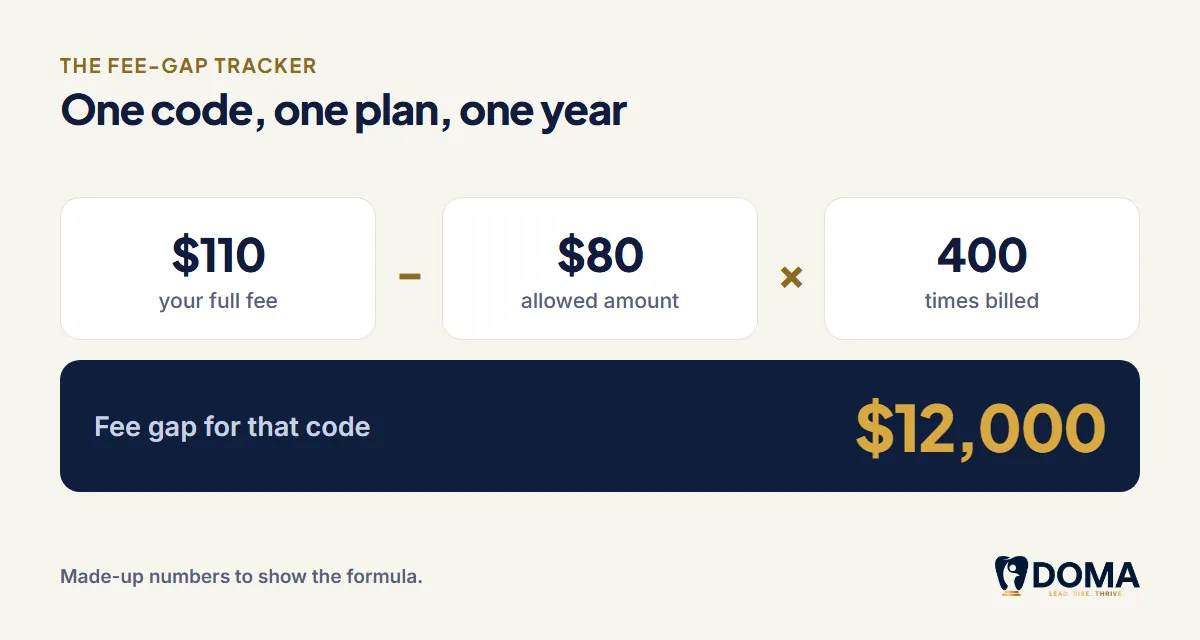
| Gap $ | (Full fee − allowed) × annual volume |
| Requested fee | What you’re asking for |
| Date requested | When the letter went out |
| Rep | Name and contact at provider relations |
| Response | Yes / no / counter / pending |
| Counter | The plan’s counteroffer, if any |
| Final | The agreed fee |
| Effective date | From the signed amendment |
| Verified on EOB (Y/N) | Did the next EOBs actually reflect it? |
Here’s a hypothetical example of how the gap math works. Say a plan allows $80 for a code, your full fee is $110, and you billed it 400 times last year. The gap is ($110 − $80) × 400 = $12,000 for that one code. These numbers are made up to show the formula. Your own will be different.
Add up the gap for each plan, then rank the plans. Start with the one where the gap is biggest and your leverage is strongest.
The same columns feed the break-even model in our companion post on going out of network. Build the sheet once and it does double duty.
Timing
Start with the contract. Find your contract anniversary or renewal date, the term, and whether it auto-renews. The ADA’s guide to provider contracts is a good checklist for what to look for.
Ask every year. The ADA says “good practice is to review your contracted fee schedules annually” and to “re-negotiate periodically.” Put it on the calendar like any other annual task.
Allow time. One vendor guide, from Avized, estimates the process “typically takes 60 to 90 days from request to effective date.” Treat that as one vendor’s estimate, not a promise. Some carriers will take longer.
Use natural touchpoints. Re-credentialing, or credentialing a new provider, puts you in contact with the carrier anyway. Cycle lengths vary by carrier and by state, so check your own contract and carrier rather than assuming a schedule.
How to Ask
Find the Right Person
The ADA says to identify “the payer’s provider representative assigned to your region,” often titled “provider relations manager.” Your billing team may already know the name.
Start with email, as the ADA suggests. If you’re comfortable, ask for a call, or keep making your case in writing.
Always be respectful. The ADA’s advice is to let the rep know you value the patients you get as a network dentist. That’s true, and it’s a better opening than a complaint.
The Letter
Keep it short. Let the attachment do the work.
Dear [Provider Relations Manager],
I’m writing to request a review of the contracted fee schedule for [Practice Name], TIN/NPI [__], a participating provider since [year].
We currently see [#] of your members. Our fee schedule was last updated in [year].
Attached is a summary of our 15 highest-volume procedures with current allowed amounts and the fees we are requesting. I’ve also included our appointment availability for your members and the efficiencies we provide: electronic claims, EFT and online eligibility verification.
We value caring for your members and would like to continue. Please confirm receipt and respond in writing by [date].
Thank you, [Name], Office Manager [Practice] · [Phone] · [Email]
Attach: the tracker extract (code, description, annual volume, current allowed, requested fee). Don’t send your cost model or internal notes.
The AADOM guide on adjusting your fee schedule says the letter “should state that you want a response in writing within 30 days.” That’s why the letter asks for a written response by a date.
The Call Script
Use this when you follow up, or when the rep prefers the phone:
“Hi, I’m [name], office manager at [practice], provider ID [__]. I sent a fee schedule review request on [date], reference number [#]. Can you confirm it’s with the right team, and when we can expect a response? Is there anything else you need from us? And does this fee schedule also apply to any leased networks?”
Write down the rep’s name, the date, and what they said. Every call goes in the tracker.
What not to say:
- “Other offices in town are getting $X.” (Even if you heard it, you shouldn’t have, and you shouldn’t repeat it.)
- “We and the practices down the street will all drop you.”
- Anything misleading about your volume or access.
What to Ask For
You have two basic options:
- Code-specific increases on your top codes, especially the ones closest to or below your cost.
- A percentage increase across the whole schedule.
Some offices ask for both, with the code list as the priority.
How much? One consultant, Ryan Smith DDS, suggests asking “for about 10 percent.” That’s one consultant’s suggestion, not an industry benchmark. Your ask should come from your own gap and cost numbers.
Also ask whether the carrier leases its network, and whether the revised fees will apply to any networks you’ve been leased into. The ADA lists this specifically. A raise on one schedule doesn’t help much if most of those patients come through a leased network on an old schedule.
Know Your Walk-Away Number
Before you send anything, sit down with the owner (and the CPA) and use the break-even model from the going-out-of-network post to agree on:
- The minimum fee level that makes this plan worth keeping.
- What you’ll do if the plan doesn’t get there: stay and re-ask in 12 months, limit how much of the schedule goes to this plan, or go out of network.
This is a decision for your practice only. Keep it between you, the doctor and your advisors. Never announce it to other practices.
Follow-Up and Handling a No
Get a reference number. If you didn’t get a confirmation, call for one.
Follow up at 30 days. That lines up with the 30-day written response the AADOM guide recommends asking for. Put the date in the calendar the day you send the letter.
Be patient. The ADA’s words: “Be patient and don’t give up! The first offer you receive may not be the best offer.” The ADA also says to set realistic expectations, since this “will rarely result in complete success in getting all of the changes you desire.”
Counter with data. If the plan offers less than you asked, go back to the tracker. Which codes are still below cost? Lead with those.
If the answer is no: ask what the plan would need to see to reconsider, and when you can ask again. Record both in the tracker. A no this year is a starting point for next year, not the end of the file.
Get it in writing. The ADA says assurances from a provider rep “should be reduced to writing. Mere oral representations are not sufficient.” If someone tells you something on the phone, follow up with an email that restates it and ask them to confirm.
After a Yes
A yes on the phone isn’t done. Here’s the close-out:
- Get the signed amendment and the effective date. Keep copies of all signed documents, as the ADA advises. Have your attorney review the amendment before anyone signs.
- Update the fee schedule in your practice management software for that plan, effective on the right date.
- Check the next EOBs. The ADA says to check that the fee changes are “appropriately reflected.” Mark it Y or N in the tracker.
- Set a calendar reminder for next year’s review.
The EOB check is the step that gets skipped.
Free guide
The 10 Reports Every Dental Practice Should Run Every Month
The monthly side of your numbers on one page. Free checklist.
Get the free guideWhen Negotiation Fails: The Out-of-Network Decision
Sometimes the numbers don’t get there. You asked with data, you followed up, you countered, and the plan still pays below what it costs you to deliver care.
That’s when the walk-away number earns its keep.
Going out of network is a big decision with real effects on patients, scheduling and cash flow. We cover the break-even math, the contract terms to check, and how to tell patients in When Going Out of Network With a Dental PPO Makes Sense.
Two rules apply here:
- An individual practice can tell its own plan its own decision. That’s yours to make.
- Don’t threaten termination as leverage together with other practices. A letter saying several named dentists will leave unless fees go up is the kind of thing the Michigan Dental Association calls price-fixing.
Before you give notice, read your contract for the termination notice period, post-termination obligations, and any all-products clause (state law may limit these, the ADA notes, so check your state and your contract). Check your state’s rules on balance billing and patient notification too. They vary.
If you’re still comparing plan types, the PPO vs. HMO post lays out the differences from a manager’s side of the desk. And the ADA’s Participating in a Plan page is a solid primer.
Where AI Helps (and Where It Doesn’t)
AI can save you real time here. It can help you organize a fee schedule export into the tracker columns, write the gap formulas, rank plans, and tighten the first draft of your letter.
Keep it PHI-safe. Fee schedules and code counts don’t need patient names, dates of birth or chart notes. Strip them out before anything goes into an AI tool.
What AI can’t do: know your contract, read the rep on the phone, or decide with the doctor where the walk-away line is.
AI is useful for building the case faster. The manager still has to own the ask.
Related: What Should an Office Manager Plan Before January? The 2027 Year-End Checklist
FAQ
Can a dental office negotiate PPO fees?
Yes. A participating practice can ask a carrier to review its contracted fee schedule. The ADA’s Fee Schedule Negotiation Guide walks through the data to bring. Results vary, and the ADA notes negotiations “will rarely result in complete success,” so plan to ask with data and follow up.
What data do I need to negotiate with a dental insurance carrier?
Your highest-revenue procedure codes for that plan, how often you bill each one, the current allowed amount, how much each contributes to revenue, and your desired fee (ADA). Add your full fee, your cost estimate, the date of your last fee revision, and your access and efficiency strengths.
Who do I contact to negotiate dental PPO fees?
The carrier’s provider relations representative for your region, often titled “provider relations manager” (ADA). Your billing team may already have the contact. Start by email, then follow up by phone.
How much of a fee increase should we ask for?
Base it on your own gap and cost numbers. One consultant suggests asking for about 10 percent, but that’s one suggestion, not a benchmark. Code-specific asks on your top codes are easier to justify than a flat number.
How long does dental PPO fee negotiation take?
It varies by carrier. One vendor guide (Avized) estimates 60 to 90 days from request to effective date. Ask for a written response within 30 days (AADOM), and follow up if you don’t get one.
How often can we ask for a fee schedule increase?
The ADA recommends reviewing your contracted fee schedules annually and re-negotiating periodically. Check your contract for renewal dates and any terms about fee reviews.
What should we do if the carrier says no?
Ask what the plan would need to reconsider and when you can ask again, record it in your tracker, and re-ask next cycle. If the fees stay below your walk-away number, evaluate whether going out of network makes sense for your practice.
Can we talk to other dental offices about their PPO fees?
No. The ADA says to negotiate individually and not to discuss fee schedules or other contract points with colleagues or peers. Sharing fees, rates, negotiation plans or plans to drop a carrier with competing practices raises antitrust risk. Talking about process, like who to contact, is fine. Ask an attorney about your situation.
The Bottom Line
In a lot of offices, the fee schedule stayed flat because nobody asked.
Pull the data. Build the tracker. Send the letter. Follow up at 30 days. Check the EOB.
Then do it again next year.
That’s where I’d start.
Clean claims are part of your leverage. Our free guide, Maximizing Dental Insurance Benefits, covers claim accuracy and cutting billing errors, the same efficiencies carriers look at. For more, see our dental insurance billing guide and billing resources.
Want AI to do the heavy lifting on the spreadsheet? AI Ready Certification teaches dental office managers to use AI safely for work like building a fee-gap spreadsheet and drafting a carrier letter, with no PHI. It’s $297, with 6 modules and 36 lessons, self-paced, and backed by our 14-day promise.
And you don’t have to figure this out alone. There are 27,000+ dental professionals in our network. Join the Dental Office Managers Community (or start at the DOMA community page) and ask about the process: who to contact, how long it took, how you organized your packet. Please never post fees, rates or negotiation plans. Antitrust law applies to fee discussions between competing offices.
Free guide
Maximizing Dental Insurance Benefits
Going through fees and coverage with patients? Get DOMA’s free guide to estimates, secondary plans and cleaner claims.
Get the free guideAI Ready Certification
Use AI safely in the office
The Dental AI Standard’s AI Ready Certification is $297, with 6 modules and 36 lessons. It’s self-paced and comes with a 14-day promise.
See the certificationDOMA community
What’s your process for asking carriers for a fee review?
Ask 27,000+ dental office managers who they contact and how long it takes. Please never post fees, rates or negotiation plans.
Join the communityFree for dental office managers
Get the Free Starter Kit
4 ebooks and 2 course previews from Kyle Summerford, plus free membership and a combined DOMA audience of 50,000+ dental professionals. No credit card.


