
Dental Coordination of Benefits: Which Plan Is Primary, How to Bill the Secondary, and When to Post the Write-Off
Which dental plan pays first, how the birthday rule works, how to bill the secondary, and how to post the write-off once, with worked examples for the front desk.

Key takeaways
- The plan covering the patient as employee or main policyholder is usually primary. For a child, the parent whose birthday comes first in the calendar year is primary, unless a court order differs.
- Bill the primary at your full fee and post only the primary payment when the EOB arrives. Then send the secondary the claim with the primary's EOB.
- Post the write-off once, after every plan has paid. Posting after each plan can create a wrong credit on the patient's balance.
- Verify each secondary plan's method, standard COB or non-duplication, before the appointment. Don't tell a patient "your secondary will cover the rest."
- Re-verify every dual-coverage patient in January. If plans overpay, contact the last plan to pay before refunding the patient.
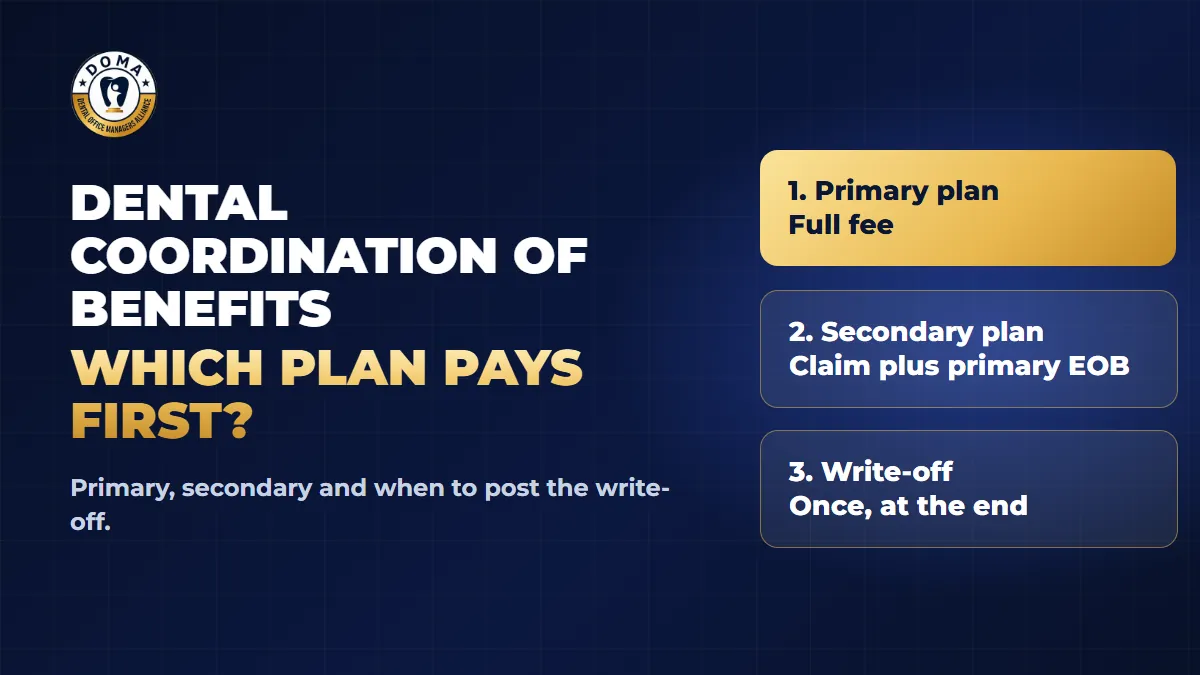
In dental coordination of benefits, the plan covering the patient as the employee or main policyholder is usually primary. For a child, the birthday rule usually decides: the parent whose birthday comes first in the calendar year. A court order overrides it. Bill the primary at your full fee. Send the secondary the claim with the primary’s EOB. Post the write-off once, after every plan has paid.
January makes all of this harder. People change employers, a spouse’s plan changes, and maximums reset, so a patient who was simple in December may not be simple on January 2. Re-verify every dual-coverage patient in January.
Free guide
Maximizing Dental Insurance Benefits
Get Kyle Summerford’s free guide on primary and secondary insurance, COB methods and the correct order for claim submission.
Get the free guideAll of this depends on state law, on whether a plan is fully insured or self-funded, and on each plan’s contract. This is general information, not legal, insurance or billing-compliance advice, so verify with the plans.
What Dental Coordination of Benefits Is
Coordination of benefits (COB) sets the order in which plans pay. The NAIC model regulation also lets secondary plans reduce their benefits so the combined benefits of all plans don’t exceed total allowable expenses. Two plans can help a patient, and they still won’t pay the claim twice.
The NAIC regulation is a model. Many states base their rules on it, some change it, and self-funded plans generally follow their own plan documents. The ADA also notes that only group (employer) plans are required to coordinate.
Primary vs Secondary Dental Insurance: Which Plan Is Primary?
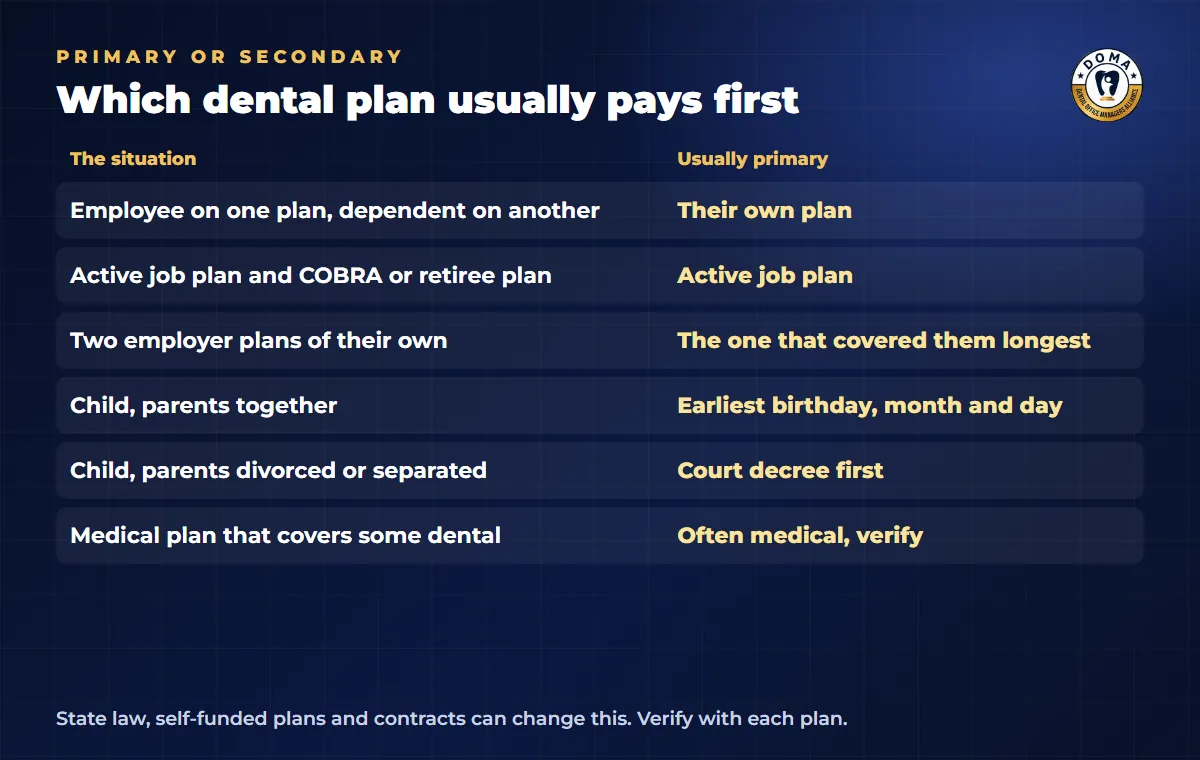
| Situation | Usually primary | Source |
|---|---|---|
| Employee or main policyholder on one plan, dependent on another | Their own plan | ADA |
| Active employment plan and a COBRA or retiree plan | The active employment plan | ADA |
| Two employer plans of their own | The plan that has covered them longest | ADA |
| Child, parents married or living together | Birthday rule: month and day only. Same birthday: the plan that has covered that parent longest | NAIC model |
| Child, parents divorced or separated | The court decree first. With no decree, many states follow the NAIC model and go to the custodial parent’s plan | ADA, NAIC model |
| Medical plan that covers some dental, such as oral surgery | Often the medical plan. Verify | ADA |
Free guide
Maximizing Dental Insurance Benefits
Get Kyle Summerford’s free guide on primary and secondary insurance, COB methods and the correct order for claim submission.
Get the free guideThe Dental Birthday Rule, With Examples
Example: Mom was born March 3, 1990, and Dad was born June 1, 1985. Mom’s plan is primary for their child, because March comes before June. Dad is older, and that makes no difference. The NAIC model says a birthday refers only to the month and day.
Example: Maria has her own employer plan and is also a dependent on her spouse’s plan. Maria’s own plan is primary for Maria, and the spouse’s plan is primary for the spouse. Their child follows the birthday rule.
Example: A patient has a new employer’s plan and is still on COBRA from the old job. The active employer plan is primary.
For divorced or separated parents, the ADA says the court’s decree takes precedence. The NAIC model defines the custodial parent as the one a court decree awarded custody. With no decree, it’s the parent the child lives with for more than half the calendar year.
When the Rules Don’t Apply
Slow down and verify with each plan in these cases:
- Self-funded (ERISA) plans, which generally follow their own plan documents.
- Individually purchased policies. The CDA says these won’t coordinate benefits.
- A plan with no COB provision. Under the NAIC model it’s generally primary, but confirm with the plan.
- Medicare, Medicare Advantage or Medicaid. Ask each plan, and don’t assume an order.
How the Secondary Calculates: Standard COB vs Non-Duplication of Benefits
Two plans don’t always add up to 100%. The secondary’s method decides what it pays. In these examples, the allowed amount is $100 and both plans pay 80%, so the primary pays $80.
- Standard COB: the secondary may pick up the remaining $20. The CDA uses the same 80/20 example.
- Non-duplication: the secondary would also have paid $80, which isn’t more than the primary paid, so it pays $0.
The ADA says non-duplication is typically used in self-funded dental plans, that ADA policy opposes these provisions, and that California has passed legislation prohibiting them.
So don’t tell a patient “your secondary will cover the rest.” Verify the method for each plan before the appointment. A clear insurance determination letter helps when the news isn’t good.
AI Ready Certification
Writing patient COB explanations with AI?
AI Ready Certification covers AI in the office manager’s daily work: six self-paced modules and 36 practical lessons, with a verifiable badge and a 14-day promise. Use it to draft explanations and checklists, and keep PHI out of public tools. Which plan is primary is still your call to verify with the plans.
See the certificationHow to Bill Secondary Dental Insurance
- Verify both plans before the visit. The insurance verification checklist and verification form will keep that consistent.
- Enter both plans in your practice software in the right order.
- Bill the primary at your full office fee. The CDA says not to submit negotiated fees, such as PPO fees.
- When the primary’s EOB arrives, post the primary payment only.
- Send the secondary the claim at your full fee plus the primary’s EOB, electronically with the attachment if the payer accepts it.
- Post the secondary payment.
- Calculate the write-off and the patient balance.
- Check for an overpayment.
Posting the Secondary Dental Claim Write-Off Once, After Every Plan Has Paid
The ADA says write-offs should not be posted until all plans have paid. Post one after the primary and another after the secondary, and you can end up with a credit on the patient’s balance that shouldn’t be there. ADMC suggests running a report of accounts with credit balances, since those can point to write-offs that were too high.
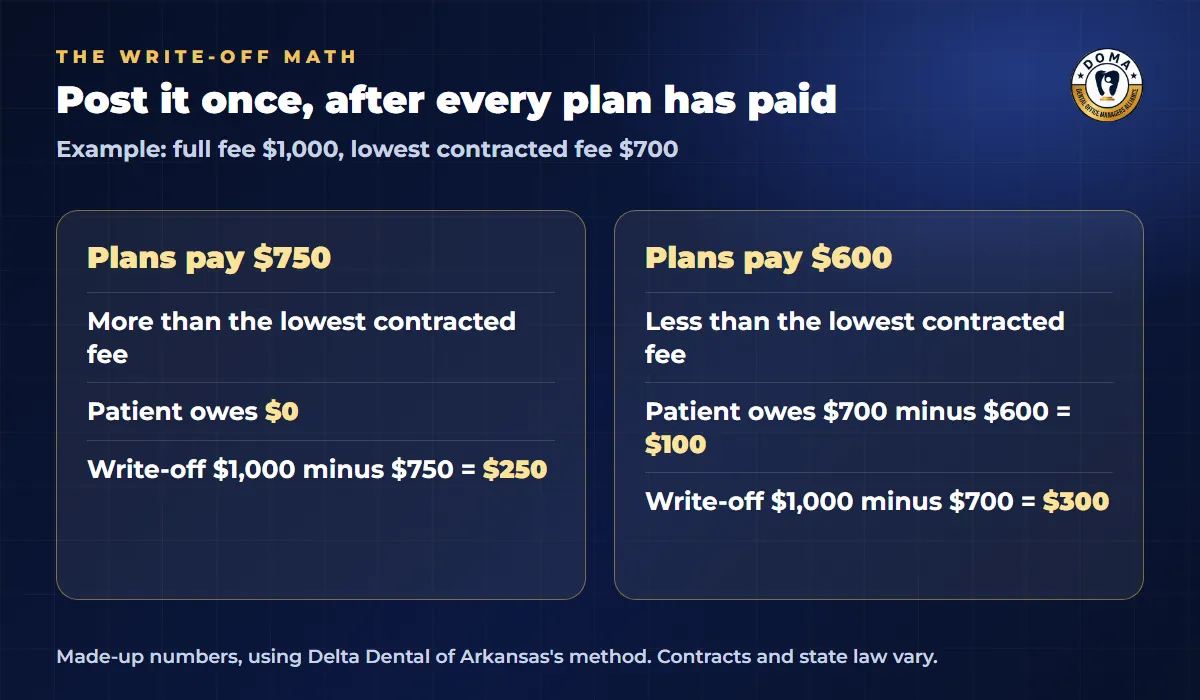
Delta Dental of Arkansas gives a formula for offices contracted with one or more plans, and says to ignore the write-off information on both EOBs:
- A is your full fee on the claim.
- B is the lowest contracted fee.
- C is the total paid by both plans.
- If C is more than B, the patient owes nothing and the write-off is A minus C.
- If C is less than B, the patient owes B minus C and the write-off is A minus B.
If C equals B, treat it as the patient owing $0. That matches the CDA‘s lowest-contracted-fee approach.
With made-up numbers, a $1,000 full fee and a $700 lowest contracted fee:
- Both plans pay $750. The patient owes $0, and the write-off is $250.
- Both plans pay $600. The patient owes $100, and the write-off is $300.
That’s one carrier’s guidance. California has its own rule if you’re contracted with one or more of the plans billed. The CDA says the patient should receive the benefit of the lowest contracted fee schedule (Health and Safety Code section 1374.19). If you’re out of network with all of them, the CDA says you aren’t required to write off any part of your fee. Contracts and state law vary, so check yours.
Once it’s right, keep it visible on the patient payment ledger and review it in your end of day close-out.
Overpayments and Credits
If the plans together pay too much, don’t refund or credit the patient yet. The CDA says to contact the last plan to pay first.
DOMA partner
Dual-coverage posting piling up?
Some offices outsource payment posting and claim follow-up. DOMA partner DayDream Dental offers DOMA members 25% off their first three months. DOMA partner. DOMA may receive compensation; offer details are set by the partner.
See the DayDream offerCommon COB Mistakes at the Front Desk
- Entering the plans in the wrong order in the practice software
- Not re-verifying dual coverage in January
- Using the PPO fee on the claim in place of your full fee
- Posting the write-off from the primary’s EOB
- Promising a non-duplication patient that the secondary will top it up
- Ignoring a court order on a child’s coverage
- Refunding a credit to the patient before calling the last plan to pay
For more on what these errors cost, read how insurance verification errors quietly cost dental offices and how to master insurance verification. If your team is sorting out plan types too, start with PPO vs HMO.
January Dual-Coverage Checklist
- Pull a list of every patient with two plans on file.
- Ask at check-in or before the visit whether either plan changed.
- Verify both plans, including the COB method.
- Confirm which plan is primary, and update the order in your practice software.
- Decide who owns this. It usually fits your insurance coordinator.
Free guide
Get the full dual-coverage checklist
Maximizing Dental Insurance Benefits gives your team a repeatable checklist for verifying dual coverage before the visit.
Get the free guideMore resources are on our dental insurance billing and billing resources pages.
FAQ
Which dental insurance is primary if I have two plans?
Usually the plan that covers you as the employee or main policyholder comes before a plan that covers you as a dependent. An active employment plan comes before COBRA or a retiree plan. With two employer plans of your own, the one that has covered you longest is primary. Verify with both plans.
How does the birthday rule work for dental insurance?
For a child covered by both parents, the plan of the parent whose birthday comes first in the calendar year is usually primary. Only the month and day count, and the birth year doesn’t matter. If both parents share a birthday, the NAIC model makes the plan that has covered that parent longest primary.
Which plan is primary for a child of divorced parents?
The court’s decree comes first, according to the ADA. Without a decree, the NAIC model goes in this order: the custodial parent’s plan, that parent’s spouse’s plan, the non-custodial parent’s plan, then that parent’s spouse’s plan. States can differ, so verify with the plans.
What is non-duplication of benefits in dental insurance?
The secondary plan pays only if its own benefit is higher than what the primary paid. If both plans cover a service at 80%, the secondary pays nothing. The ADA says it’s typically used in self-funded dental plans and that ADA policy opposes these provisions.
How do you bill secondary dental insurance?
Bill the primary at your full office fee. When its EOB arrives, post that payment only. Then send the secondary a claim at your full fee along with the primary’s EOB. Post the secondary payment, and only then work out the write-off and the patient balance.
When should a dental office post the write-off when there are two plans?
After every plan has paid. The ADA warns that posting a write-off after the primary and again after the secondary can wrongly create a credit on the patient’s balance. Delta Dental of Arkansas also says to ignore the write-off information on both EOBs and do the math yourself.
Can a dental office collect more than the PPO fee when there is secondary insurance?
It can, depending on your contracts. ADMC says participating dentists can accept up to their full fee from multiple plans if that’s how the secondary calculates its payment. Delta Dental of Arkansas and ADMC both say the patient doesn’t owe more than the lowest contracted fee minus what the plans paid.
Do I need to re-verify dual coverage in January?
Yes. People change employers and spouses’ plans, and plans reset at the start of the year. Re-verify every dual-coverage patient in January, confirm which plan is primary, and update the order in your practice software before you send the first claim of the year.
Free guide
Keep the whole COB workflow in one place
Maximizing Dental Insurance Benefits helps your team find which plan pays first and reduce avoidable denials and claim delays. It also helps you explain patient responsibility with more confidence.
Get the free guideDOMA community
Stuck on a dual-coverage claim?
Ask 27,000+ dental office managers in the Dental Office Managers Community how they’d handle it.
Join the communityThis article is general information, not legal, insurance or billing-compliance advice. COB order and secondary payments depend on state law, whether a plan is fully insured or self-funded, and each plan’s contract. Always verify with the plans.
Free for dental office managers
Get the Free Starter Kit
4 ebooks and 2 course previews from Kyle Summerford, plus free membership and a combined DOMA audience of 50,000+ dental professionals. No credit card.


