
How to Prevent Embezzlement in a Dental Office: Controls That Protect the Practice and Its Honest Team
Who should collect, post, deposit and reconcile in a small dental office, what to check daily, weekly and monthly, the warning signs, and what to do first if you suspect theft.
By Kyle Summerford

To prevent embezzlement in a dental office, split the money jobs so no one person collects, posts, deposits and reconciles. Reconcile collections to deposits every day, restrict who can change the ledger, review the audit trail, and give the owner direct access to bank statements. These controls protect your honest team too.
Nobody enjoys writing a dental office embezzlement policy. It can feel like telling people you’ve worked beside for years that you don’t trust them. But TDIC reports that in a survey the American Dental Association released in 2020, 48% of respondents said they had been the victim of embezzlement. TDIC also reports that nearly 40% of the employees accused had been with the practice four years or more.
Free guide
Create a System of Accountability
Set clear expectations and consistent habits, so a new money rule lands as how the office runs and nobody hears it as an accusation.
Get the free guideMost advice on this topic is written for owners, or by firms that sell investigations. This one is from the manager’s chair: what you can set up yourself this month, and what you ask the owner to take.
A Recent Case, and What It Shows
In October 2026, Honolulu Civil Beat reported on a man charged in Orange County, California, with identity theft and grand theft. Dental FraudBusters summarized the dental side of the story on October 28. These are allegations. He denies them, no charges in Hawaii were reported, and he is presumed innocent. The details below are as reported on that date.
An Irvine practice alleges he answered an Indeed ad, was paid $200 by practice check for a half-day working interview, and wouldn’t agree to a background check. About $18,000 in small charges then hit the checking account, and the practice alleges the numbers on that check were used to pay a credit card.
A Honolulu practice says it hired him as office manager in May 2025 and fired him that October. It alleges he offered patients a cash discount, kept the cash and removed the procedures, and told patients to leave the payee line blank on their checks. Patients then got statements for balances they had already paid. The dentist estimates the losses at a minimum of $80,000.
Whatever the courts decide, these are well-known schemes, and each one has a simple defense.
Why Controls Protect Your Honest Office Manager Too
Say a $200 deposit comes up short. If you collected it, posted it, deposited it and reconciled the bank, you’re the only person anyone can look at. You may have done nothing wrong, and you still can’t show it.
Now say someone else reconciled, and the owner reads the bank statement directly. The record answers the question, and you don’t have to defend yourself from memory.
That’s how I’d bring this to your doctor and your team. A control means nobody has to rely on trust alone, including you. If your team needs the bigger conversation first, start with why good employees still need accountability and the team accountability system.
Free guide
Create a System of Accountability
Set clear expectations and consistent habits, so a new money rule lands as how the office runs and nobody hears it as an accusation.
Get the free guideSplit the Money Jobs: Who Does What in a Small Office
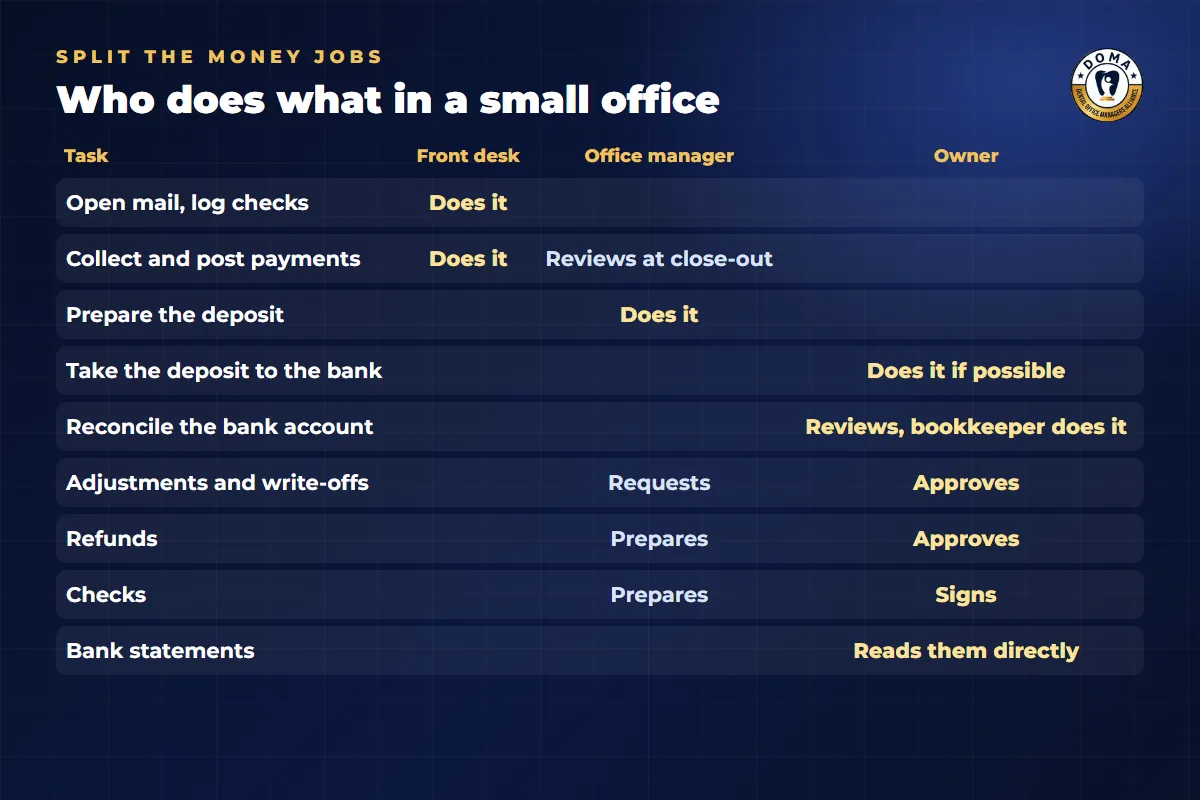
The ADA New Dentist Blog, drawing on the ADA’s manual on fraud and embezzlement, says no one person should handle both patient payments and bank deposits. If possible, it says, the dentist should make the deposits. TDIC goes further and separates reviewing bank statements, entering online payments and reconciling the bank. It also suggests having the bank send statements to the owner’s personal email.
That split is called segregation of duties. Here’s how it can look with three to five people up front:
| Task | Front desk | Office manager | Owner or dentist | Outside bookkeeper |
|---|---|---|---|---|
| Open mail and log checks | Does it | |||
| Collect patient payments | Does it | Backup | ||
| Post payments | Does it | Reviews at close-out | ||
| Prepare the deposit | Does it | |||
| Take the deposit to the bank | Does it if possible | |||
| Reconcile the bank account | Reviews it | Does it | ||
| Approve adjustments and write-offs | Requests | Approves | ||
| Issue refunds | Prepares | Approves | ||
| Sign checks | Prepares | Signs | ||
| Review bank statements | Reads them directly | Can also review |
The rule to protect: the person who collects never reconciles alone, and the owner sees the bank statement without anyone in between.
When You Only Have Two People
You can’t split everything with two people. Someone will collect and post, so lean on the owner for the rest. The owner takes the deposit, or at least compares the slip to the day sheet, and reads the statements directly.
Then add what the size of the office can’t give you. Cross-train so each person can do the other’s job, and make sure everyone takes real vacation, with someone else running the desk while they’re out. The ADA also says payroll and inventory checks should happen randomly, without prior notice.
Daily, Weekly and Monthly Internal Controls
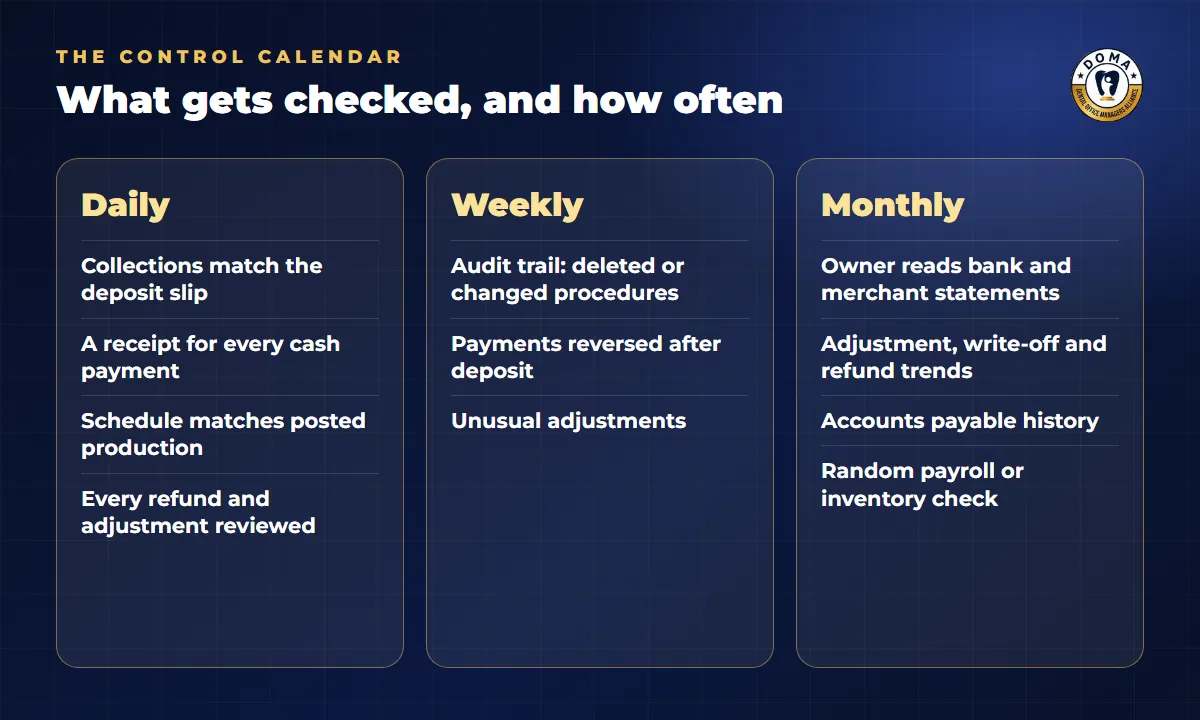
Controls only work on a schedule. Give each of these a name and a day.
Daily
- Compare what was collected to the deposit slip. The ADA says to run a check register daily and compare it to that slip.
- Give a receipt for every cash payment.
- Compare the schedule to posted production, so a patient who was seen has a procedure on the ledger.
- Review every refund and adjustment made that day.
Free guide
End of Day Close-Out Checklist
Your daily first line of defense: reconcile payments, verify deposits and leave nothing open overnight. Free PDF from Kyle Summerford.
Get the free guideWeekly
- Review the audit trail for deleted or changed procedures.
- Run the audit report TDIC recommends for payments posted and then reversed after deposit.
- Look at unusual adjustments, and ask what each one was for.
Monthly
- The owner reads the bank and merchant statements directly.
- Look at the trend in adjustments, write-offs and refunds, plus your aging report. The 10 monthly reports cover most of this.
- Run the accounts payable history and look for vendors you don’t recognize.
- Do a random payroll or inventory check.
If collections and AR are already a mess, clean those up first with the financial reset.
Lock Down Checks, Cash and the Bank Account
- Tell patients to make checks out to the practice and never leave the payee line blank. Say it at the desk and on your statements. FraudBusters also says to stamp every check “For Deposit Only” as soon as it arrives.
- Have someone other than the person who collected prepare or review the deposit.
- Treat “pay cash for a discount” as a red flag. Any discount should come from a written policy and show on the ledger.
- Pay working-interview shifts through payroll or direct deposit, so a practice check with your account numbers doesn’t leave the building. Ask your bank about ACH debit blocks or filters on the operating account.
- Secure your check stock, keep documentation for every check signed, and give the bank a list of approved vendors and signers (TDIC).
- Issue refunds to the original payment method only, and keep them on the daily review.
- Use a receipt and a clear patient payment ledger, and put payment plans in a signed patient payment agreement.
Lock Down Your Practice Software
Most of what you need is probably in the software you already have.
- The owner holds the highest-level login.
- Everyone has their own login, with no shared passwords. A shared login makes the audit trail useless.
- Keep the audit trail or log turned on, and review it.
- Limit who can delete procedures, post adjustments and issue refunds.
If nobody in the office really knows the security settings, TDIC suggests hiring a practice software specialist to set them up.
Hire Carefully
Run background checks before anyone starts, and that includes office managers and anyone who’ll handle money. FraudBusters recommends searching court records in every state the candidate has lived, and treats a refused background check as your answer. TDIC adds dentist-to-dentist reference checks.
Do this by the book. If you use a screening company, the FTC and EEOC say you must give the applicant written notice in a stand-alone format and get written permission first. There are more steps before you reject someone based on the report. State and local rules can add to that, so use a compliant provider and check with counsel.
For the rest of the process, see dental front desk hiring and our free guide, Hiring Front Desk That Stays.
Warning Signs of Embezzlement in a Dental Office
In the Numbers
- Increases in refunds, adjustments or write-offs
- Payments posted and then reversed after deposit
- Deposits that lag behind collections or don’t match them
- Missing deposit slips
- Patients seen on the schedule with nothing posted
- Patient statements that don’t match what the patient paid
In Behavior
- Possessiveness about duties and reluctance to cross-train
- Refusing to take vacation
- Coming in early or working late
- Offers to patients to pay cash for a discount
- “My statement is wrong” calls that never reach the owner
The first three come from TDIC. Take every statement complaint seriously, and send those calls to the owner or a second person.
No single sign proves theft. Plenty of good managers come in early and hate taking time off. When several signs show up together, verify the numbers with the owner before anyone says a word.
If You Suspect Theft: What to Do First
- Don’t confront, accuse or tip anyone off.
- Keep records as they are, and don’t let anyone delete or fix anything. Don’t go looking through personal accounts or personal devices.
- Tell the owner, privately.
- The owner calls their attorney and their insurer before any confrontation or termination, and asks whether the practice has employee-dishonesty or crime coverage. They may also bring in a forensic accountant.
- Going to the police is the owner’s decision, made with counsel.
- Keep it confidential. That protects everyone, including the person if they turn out to be innocent.
This is general guidance, not legal, HR or accounting advice. Get your own advice for your state and your situation.
A 30-Day Setup Plan for an Office Manager
This came up at our Plug the Leaks event in North Charleston in October, presented by Archy and the Dental Office Managers Community (Archy is a DOMA partner). The agenda included internal controls an office manager can set up within a month. Here’s one way to do it:
- Week 1: Fill in the duty table with real names, and give everyone their own login.
- Week 2: Start the daily close-out, plus the check and cash rules. Tell patients about the payee line.
- Week 3: Turn on the audit trail review, and talk to the bank about statements, signers and ACH blocks.
- Week 4: Set the owner’s monthly review, and write your hiring checklist.
Free guide
Start with today’s close-out
The End of Day Close-Out Checklist walks your team through checking out every patient, reconciling payments and verifying deposits, so the daily controls in this article have a home.
Get the free guideAI Ready Certification
Writing your control checklists with AI?
AI Ready Certification covers AI in the office manager’s daily work: six self-paced modules and 36 practical lessons, with a verifiable badge and a 14-day promise. Use it to draft routines and checklists, and keep patient and financial data out of public tools.
See the certificationFAQ
How can a dental office prevent embezzlement?
Split the money jobs so no one person collects, posts, deposits and reconciles. Reconcile collections to the deposit every day, give everyone their own software login, keep the audit trail on and review it weekly, and have the owner read bank statements directly.
What are the most common signs of embezzlement in a dental practice?
In the numbers, watch for rising refunds, adjustments and write-offs, payments reversed after deposit, deposits that don’t match collections, and patients disputing their statements. In behavior, TDIC lists possessiveness about duties, reluctance to cross-train and refusing vacation. No single sign proves theft.
Which financial duties should be separated in a dental office?
The ADA says no one person should handle both patient payments and bank deposits. TDIC also separates reviewing bank statements, entering online payments and reconciling the bank. Keep preparing a check apart from signing it, and have the owner approve adjustments, write-offs and refunds.
How often should a dental practice reconcile deposits?
Every day. At close-out, compare what was collected to the deposit slip and account for any difference before you go home. The owner or an outside bookkeeper then reconciles the bank account against the statements each month, separately from whoever collected the money.
How does a practice management software audit trail help prevent theft?
The audit trail records who changed what. Reviewing it shows deleted or changed procedures and unusual adjustments, and TDIC recommends an audit report for payments posted and then reversed after deposit. It only works if everyone has their own login and the owner holds the highest-level access.
What should a dental office do if it suspects employee theft?
Tell the owner privately and don’t confront anyone. Keep records as they are, so nothing gets deleted or fixed. The owner should then call their attorney and insurer before any confrontation or termination. This is general guidance, not legal advice.
Do internal controls protect honest employees?
Yes. When someone else reconciles the deposit and the owner sees the bank statement, an honest office manager has a record behind them if money goes missing. Nobody has to rely on memory or on trust alone to show what happened.
DOMA community
How do other small offices split the money jobs?
Ask 27,000+ dental office managers in the Dental Office Managers Community how they handle it with two or three people up front.
Join the communityFree for dental office managers
Get the Free Starter Kit
4 ebooks and 2 course previews from Kyle Summerford, plus free membership and a combined DOMA audience of 50,000+ dental professionals. No credit card.


