
Implant-Supported or Abutment-Supported? The 2027 Implant Crown Coding Change for the Front Office
From Jan 1, 2027, a screw-retained implant crown on a lab abutment is abutment-supported. Report D6056 or D6057 with the crown. What changed and a 5-step front office checklist.
By Kyle Summerford

Starting with dates of service on Jan 1, 2027, the ADA’s Coding Companion says a screw-retained implant crown that the lab builds on an abutment is abutment-supported, not implant-supported. Report the abutment (D6056 prefabricated or D6057 custom) with the crown. Implant-supported now means a crown on a one-piece implant only. This change is not on the CDT 2027 change list, so check each payer’s policy.
Coding guidance and payer policies vary. Check the current CDT manual, the Coding Companion, and each plan’s policy before you bill. This is front-office workflow, not clinical advice.
Free guide
Adding the implant crown question to verification?
Insurance Verification That Actually Protects Production is a free guide to a verification process that catches plan limits before the patient is in the chair.
Get the free guide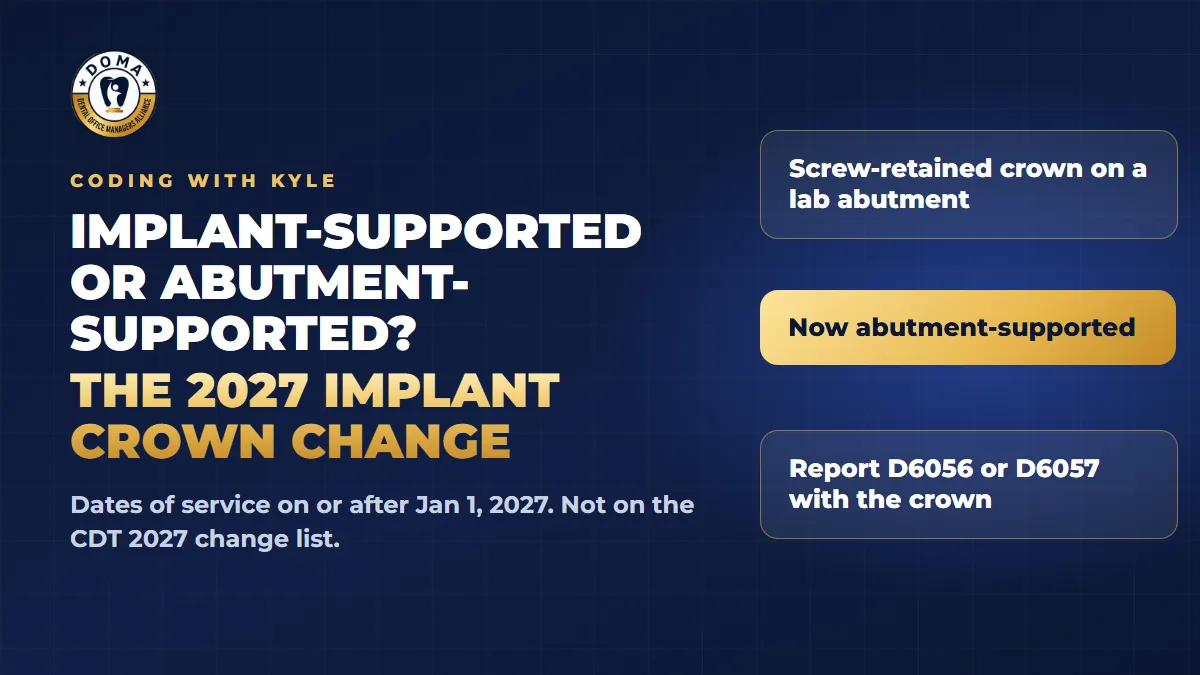
Every fall, billing teams print the CDT change list, highlight the new codes, and update the fee schedule. Good habit. This year, it won’t catch everything.
One of the biggest changes for offices that restore implants isn’t a new code at all. It’s a definition. And if your team only works from the CDT 2027 change list, you’ll miss it.
Estela Vargas, CRDH, laid it out in DrBicuspid on Nov 10, 2026. She says she compared notes with coding experts Greg Grobmeyer and Rick Garofolo, and they agree on what it means for the front office.
What Changed on Jan 1, 2027 (and Why It’s Easy to Miss)
The ADA made 67 changes to the CDT Code for 2027: 28 additions, 33 revisions, and 6 editorial changes, per the ADA Code Maintenance Committee. The implant crown change is not one of them.
It lives in the 2027 Coding Companion, in the definition of an implant-supported crown. The crown codes themselves didn’t change. What changed is which code a screw-retained crown belongs under.
That’s why it slips through. Change lists, payer bulletins, and AI summaries built from those lists cover the 67 code changes. This one sits outside them.
Implant-Supported vs Abutment-Supported Crowns, in Plain Words
Abutment-supported crown. The crown attaches to a separate abutment. That abutment is either prefabricated (D6056) or custom (D6057). You report the abutment and the crown. Vargas notes CDT describes this crown as “retained, supported and stabilized by an abutment on an implant.”
Implant-supported crown. The crown attaches directly to the implant, so there’s no abutment to report. CDT describes it as “retained, supported and stabilized by an implant.” Per Vargas, adding an abutment to one of these claims usually gets denied as a miscode.
What moved. Through 2026, the Coding Companion called a crown implant-supported if it reached the mouth as one piece. A lab-built abutment counted as part of manufacturing, so you reported only the crown. Vargas says many offices billed the abutment anyway, and some payers audited those claims and took the payments back.
From 2027, implant-supported means the crown attaches directly to a one-piece implant with no separate abutment, whether the abutment is made in the lab or placed in the mouth. The ADA’s examples are mini-implants, monotype implants, and other one-piece implant bodies.
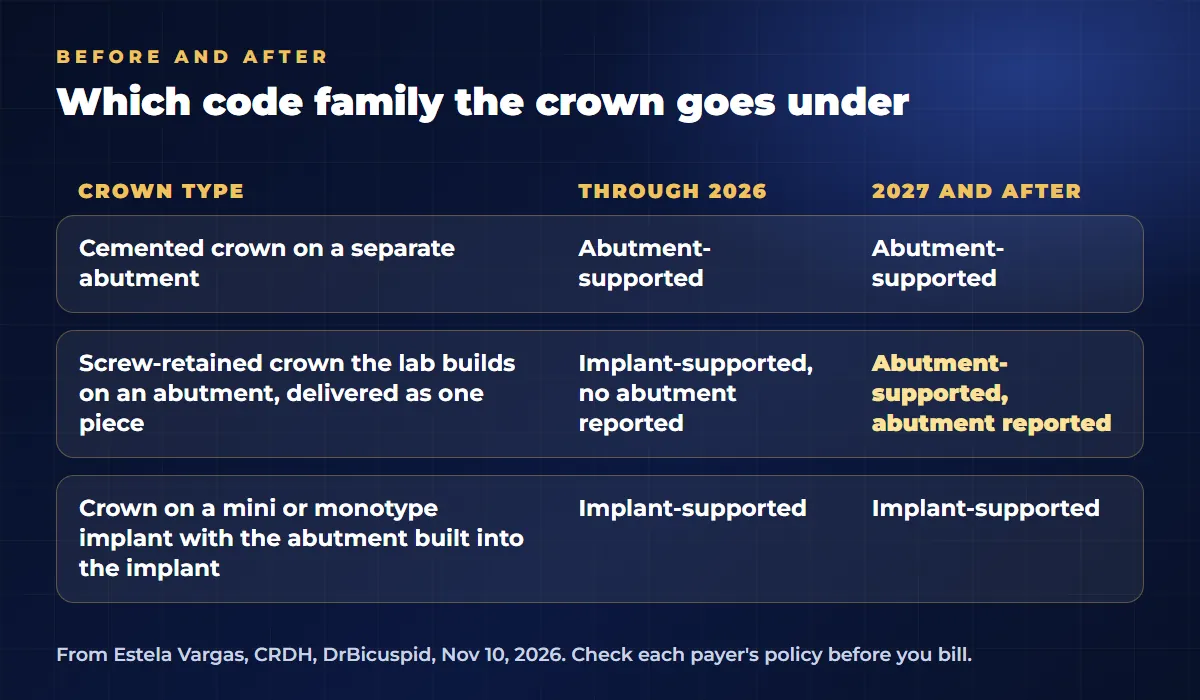
Here’s the before and after, from Vargas’s article:
| Crown type | Through 2026 | 2027 and after |
|---|---|---|
| Cemented crown on a separate abutment | Abutment-supported | Abutment-supported |
| Screw-retained crown the lab builds on an abutment, delivered as one piece | Implant-supported, no abutment reported | Abutment-supported, abutment reported |
| Crown on a mini or monotype implant with the abutment built into the implant | Implant-supported | Implant-supported |
The code families, so your team can find them
These are single-crown ranges as the ADA lists them in its Coding Companion text. Confirm against your current CDT manual before you update templates.
- Abutments: D6056 prefabricated abutment, includes modification and placement. D6057 custom fabricated abutment, includes placement.
- Abutment-supported single crowns: D6058 to D6064, D6094, and D6097. For example, D6058 is an abutment supported porcelain/ceramic crown.
- Implant-supported single crowns: D6065 to D6067 and D6082 to D6088. For example, D6065 is an implant supported porcelain/ceramic crown.
Pick the crown code by material, by whether it’s a single crown, a retainer, or a pontic, and by whether it’s abutment-supported or implant-supported. Bridge retainers have their own codes, so check the manual for those.
If you want a refresher on the surgical side, see our posts on D6010 implant body placement and the regular platform endosteal implant code.
Which Claims This Affects
Mostly, screw-retained crowns built on a lab abutment. Vargas says implant-supported is now limited to crowns on one-piece implants, which is a small share of what most offices place. So for many practices, this touches most implant crown claims going forward.
Two things decide which rules apply:
- The date of service, not the date you send the claim. Vargas says dates of service in 2026 stay under the 2026 manual.
- What the lab actually built. If there’s a separate abutment under the crown, that’s the deciding fact. You need it in writing.
One more thing to know. On Oct 21, 2026, the ADA issued an errata notice for the 2026 Coding Companion that corrects the 2026 implant crown text to this same one-piece-implant definition. If you have a 2026 implant crown claim in question, ask the payer which guidance it follows before you send or correct anything.
The 5-Step Front-Office Checklist
These come from Vargas’s article. Here’s how I’d run them in the office.
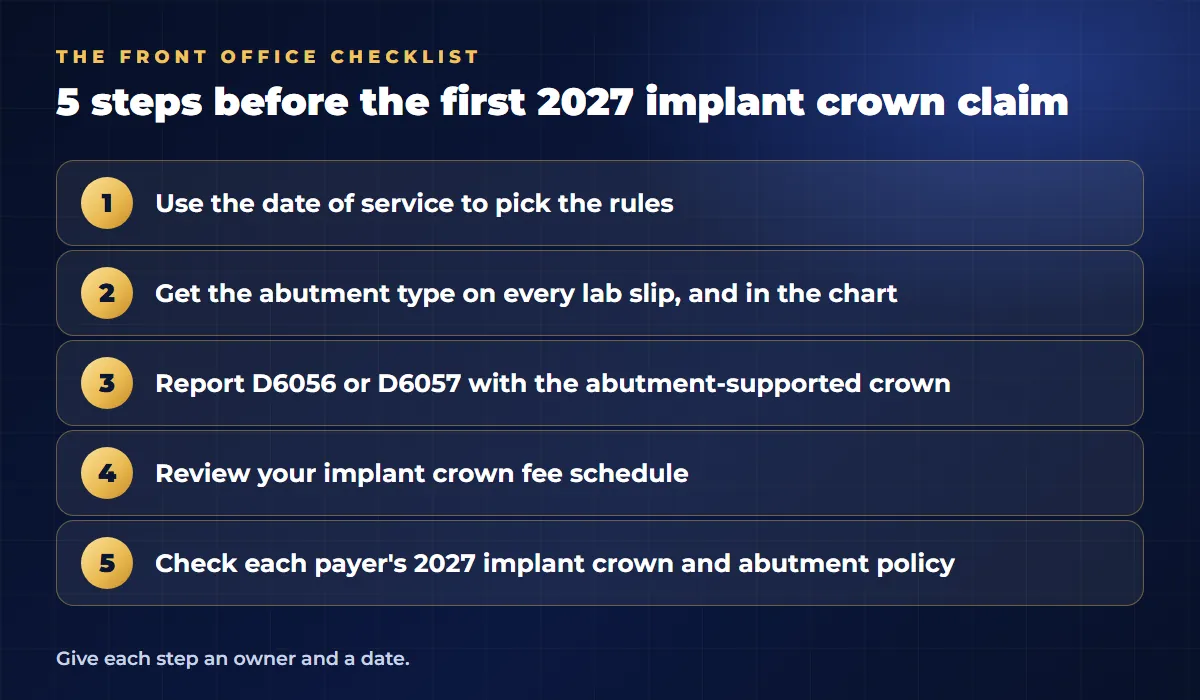
- Use the date of service to pick the rules. On or after Jan 1, 2027, use the new definition. 2026 dates of service stay on the 2026 rules. Put this in writing for whoever builds claims.
- Get the abutment type on every lab slip. Ask your lab to list the abutment type, prefabricated or custom, on every implant crown slip. Record it in the chart. Vargas says most labs already do this. If yours doesn’t, ask now, not in January.
- Report the abutment with the abutment-supported crown. Use D6056 or D6057 to match what the lab built, with an abutment-supported crown code. Don’t pair an abutment with an implant-supported crown code.
- Review your fee schedule. If your office raised its implant-supported crown fee to cover a lab-built abutment, reset it so the crown and abutment fees aren’t covering the same cost.
- Check each payer’s policy. The Coding Companion is ADA guidance. Plans adopt changes on their own schedules. Add “implant crown and abutment policy for 2027” to your insurance verification checklist for patients with implant treatment planned.
Assign each step an owner and a date.
Free guide
Adding the implant crown question to verification?
Insurance Verification That Actually Protects Production is a free guide to a verification process that catches plan limits before the patient is in the chair.
Get the free guideCases That Cross Jan 1
This is where offices will get tripped up in January.
Implant crowns take more than one visit. A case might be scanned in December and seated in January. Payers don’t all treat the same visit as the crown’s date of service. Many use the seat or delivery date. Some use the prep or final impression date.
So before any implant crown claim with dates on both sides of Jan 1 goes out:
- Know which date each payer uses for an implant crown’s date of service.
- Ask the payer which definition it will apply to that claim.
- Have one person check the seat date against the lab slip before the claim is sent.
- Document who you talked to and what they said.
And never change a date to land a claim in the year that pays better. Report what happened, when it happened.
Hypothetical example: A patient’s screw-retained crown on a custom lab abutment is seated on Jan 6, 2027. Under the 2027 definition, the claim would show the custom abutment (D6057) plus an abutment-supported crown code for the material used. If the payer hasn’t adopted the 2027 guidance yet, call before you send and note the answer.
DOMA partner
Drowning in implant claim follow-up?
If your team is drowning in implant claim follow-up and payer calls, some offices outsource that work. DOMA partner DayDream Dental handles claim follow-up and offers DOMA members 25% off the first three months of service. DOMA partner. DOMA may receive compensation; offer details are set by the partner.
See the DayDream offerKyle’s Take
Vargas sums it up well:
“Code what you do. If the crown you seat has a separate abutment under it, report both.”
I’d add this. The coding part is the easy part. The hard part is the handoff. The lab knows what it built. The clinical team knows what it seated. The billing team is the one sending the claim. If the abutment type isn’t on the slip and in the chart, your biller is guessing. Fix the handoff before January.
Miscoded abutments are a denial and audit risk. We’ve covered why dental insurance denials are increasing. This is one you can get ahead of.
FAQ
Is the implant crown change part of CDT 2027?
No. It is not one of the 67 official CDT 2027 changes. It is in the ADA’s 2027 Coding Companion, in the definition of an implant-supported crown. The crown codes did not change. Which code a screw-retained crown on a lab abutment belongs under did.
Do I report the abutment on a screw-retained implant crown in 2027?
Yes, if the lab built the crown on a separate abutment. For dates of service on or after Jan 1, 2027, that crown is abutment-supported, so report the abutment (D6056 prefabricated or D6057 custom) with an abutment-supported crown code. Check each payer’s policy.
What counts as an implant-supported crown now?
A crown that attaches directly to a one-piece implant with no separate abutment, whether made in the lab or placed in the mouth. The ADA’s examples are mini-implants, monotype implants, and other one-piece implant bodies. No abutment is reported with these.
Does every dental insurance plan follow this on Jan 1, 2027?
Not necessarily. The Coding Companion is ADA guidance, and plans adopt changes on their own schedules. Check each payer’s policy before you bill, and document what they tell you.
What about 2026 claims I’m still sending in January?
The date of service decides, not the date you send the claim. Per Vargas, 2026 dates of service stay under the 2026 rules. The ADA did issue an Oct 2026 errata to the 2026 Coding Companion with the same definition, so ask the payer if a 2026 claim is in question.
Keep Going
- Browse more insurance and billing posts, including the Navigating Dental Coding with Kyle series.
- Looking back? Our post on the 2020 ADA coding changes covers CDT 2020, when D6082 to D6088 were added to the implant-supported crown codes.
Free guide
Maximizing Dental Insurance Benefits
Get Kyle Summerford’s free guide to reduce avoidable denials and claim delays, and explain patient responsibility with more confidence.
Get the free guideDOMA community
How is your office handling the January cutover?
Ask 27,000+ dental office managers and team members how they handle the lab slip and the January cutover in the free DOMA Community.
Join the communityCoding guidance and payer policies vary. Check the current CDT manual, the Coding Companion, and each plan’s policy before you bill. This is front-office workflow, not clinical advice.
Source: Estela Vargas, CRDH, Implant-supported or abutment-supported? How the ADA's coding change could affect your dental claims, DrBicuspid, Nov 10, 2026. Code ranges: ADA errata notice for the CDT 2026 Coding Companion, Oct 21, 2026; ADA Code Maintenance Committee March 2026 report.
Free for dental office managers
Get the Free Starter Kit
4 ebooks and 2 course previews from Kyle Summerford, plus free membership and a combined DOMA audience of 50,000+ dental professionals. No credit card.


