How to Get Your Dental Practice Recommended by ChatGPT and AI Search: An Office Manager’s Checklist
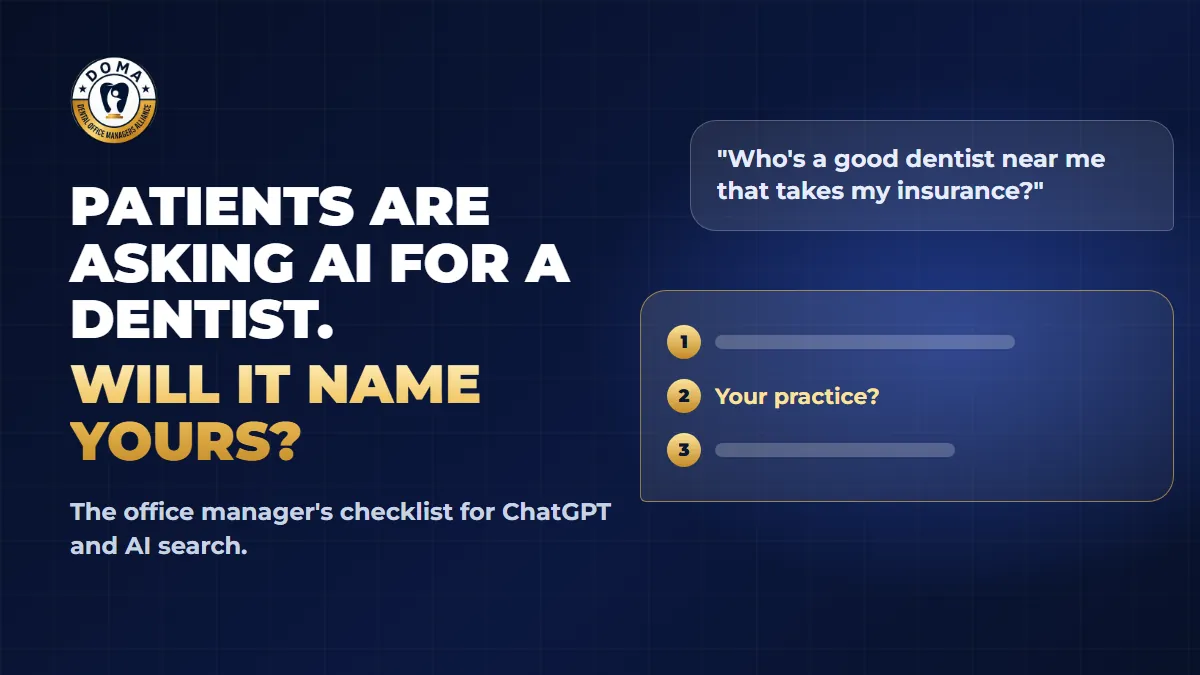
Patients are asking ChatGPT and Google’s AI to recommend a dentist. Those tools name practices they can find, verify and quote. That means matching facts everywhere, steady reviews, and service pages that answer real patient questions. Most of that work belongs to the office manager, and none of it comes with a guarantee.
A patient used to type “dentist near me” and scroll a list. Now a lot of them ask a full question, like “who’s a good dentist near me that takes Delta Dental and sees kids?”, and get back a short answer with two or three names in it.
Being one of those names is starting to matter. And when dentists hear about it, the usual next step is a sales call from someone selling “AI SEO.”
Before that call, look at what these tools actually check. Most of it is operations work: keeping your facts consistent, asking for reviews at checkout, collecting the questions your front desk hears every day. Dental office managers already run those things.
One note on where we stand: DOMA works with marketing partners, listed on our offers page. Nothing on this checklist requires hiring one.
How AI Search Decides Which Dental Practice to Name
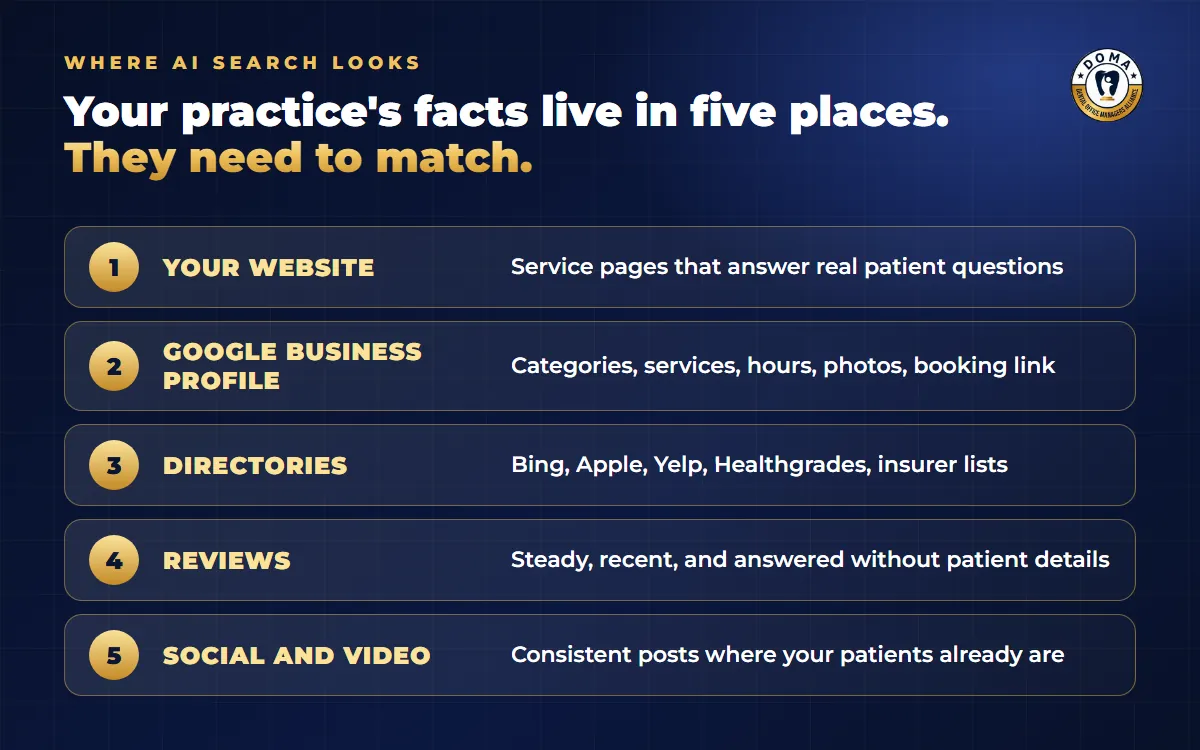
When a patient asks an AI tool for a dentist, the tool searches the web, reads what it finds, and writes a short answer. It isn’t looking at one source. It pulls from your website, your Google Business Profile, directory listings, review sites and sometimes social media, then names the practices it can describe with confidence.
If your phone number is different on Yelp, your hours are wrong on Google, and your implant page says nothing a patient would ask about, the tool has less to work with. A competitor with cleaner information is easier to name.
There’s now real data on this. Nathan Woo published a study in Dental Economics in October 2026 that ran 1,405 patient-style questions through ChatGPT (GPT-5.5, via the OpenAI API) in June and July, across 20 US metro areas and seven areas of dentistry. Practice-owned websites were 53.8% of all the sources ChatGPT cited, more than three times the next category, and 87.2% of the questions cited at least one practice site.
The share went up when the question named a specialty: 75.8% for orthodontics, 72.5% for periodontics and 60.2% for endodontics. Vague questions like “best dentist” sat near 46%, and that generic question was where directories showed up most, at 15% of sources. An earlier study of physicians, run the same way, found practice websites at 23.1%, behind hospital rosters at 27.1%. As the author explains, dentistry has no hospital roster, so the citation lands on the practice’s own site.
The 53.8% is the share of all citations that went to practice websites as a group, not the chance that ChatGPT cites your site. The study covered ChatGPT only, in the US, as a snapshot, and the author notes that Gemini, Perplexity and Google’s AI Overviews may behave differently.
The article’s example is an implant page. One that only says “We offer dental implants. Call today” gives the model almost nothing to quote. One that explains who’s a good candidate, what drives the cost, how long it takes and how it compares to a bridge or a denture gives it real material.
ChatGPT, Google AI Overviews, Gemini and Perplexity Aren’t the Same
Each tool uses its own search sources and writes its own kind of answer. Google’s AI Overviews lean on Google’s index and Business Profiles. ChatGPT runs its own web search. Perplexity shows its sources next to every answer. A practice can show up in one and not another, so test all of them.
The AI Search Checklist for Dental Office Managers
Work through these in order. The first four cost nothing but time, and they’re the ones you control directly.
1. Pick One Official Version of Your Practice Facts
Owner: Office manager
Write down the exact practice name, address format (Suite 200 or Ste. 200, pick one), main phone number, hours, website address, and each provider’s name and credentials as they should appear. Every other item on this list gets checked against this sheet.
It sounds small. In practice, it’s where most mismatches start: an old phone number from before the move, a former associate still listed, “Family Dentistry” on one site and “Dental Group” on another.
2. Fix Your Google Business Profile
Owner: Office manager
- Primary category set to the most accurate one (General dentist, Orthodontist, and so on), with secondary categories for what you really offer.
- Every service listed in plain words a patient would use.
- Hours current, including holidays and lunch closures.
- Booking link and phone number that match your official sheet.
- Real photos of the office, the team and the outside of the building, added over time.
- Posts when something changes: new provider, new service, holiday hours.
Google’s own guidelines for representing your business apply here: use the real business name, without extra keywords stuffed in.
3. Make Every Other Listing Match
Owner: Office manager
Search your practice name and phone number and list every place it shows up. Then claim and correct the main ones: Bing Places, Apple Business (formerly Apple Business Connect), Yelp, Healthgrades, Vitals, Zocdoc, the ADA Find-a-Dentist directory, your insurers’ provider directories and your Facebook page.
Watch for stale listings from an old address, a previous owner or a provider who left. Those are the ones that confuse both patients and AI tools. Fix what you can, and mark duplicates for removal where the site allows it.
4. Reviews: Steady, Recent and Compliant
Owner: Front desk, with the office manager setting the routine
A review ask at checkout, every day, beats a review push once a quarter. Ask every patient, not only the ones who seem happy. Google’s policy prohibits selectively asking for positive reviews.
Platforms have their own rules, and they differ. Yelp asks businesses not to request reviews at all, so don’t run a Yelp review campaign. Google allows asking, as long as you don’t offer incentives or select who gets asked.
Reply to reviews, good and bad, without revealing anything about the patient. The compliance section below covers what that means.
If you need a starting point for the process, DOMA’s online reviews and social media management process is a ready-made SOP.
5. Service Pages That Answer Patient Questions
Owner: Office manager collects the questions, web company builds, dentist approves
This is where the Dental Economics data points. ChatGPT leaned on practice pages most when the question was specific, so for each main service, the page should cover:
- Who it’s for, and who it isn’t for
- What to expect at each visit
- How long it takes, start to finish
- What drives the cost, and whether insurance usually helps
- Alternatives the patient might hear about
- A short FAQ written in the words patients use on the phone
Your front desk already has these questions. Keep a sheet at the desk for two weeks and write down every question callers ask about implants, Invisalign, crowns or whatever your top services are. That list is worth more to your web company than any keyword report. Your new patient phone intake form is a good place to add “How did you hear about us?” with ChatGPT or AI as an option, so you can see whether this channel is real for your office.
Clinical content needs the dentist’s approval before it goes live. That protects the patient and the practice.
6. About and Provider Pages
Owner: Dentist approves, office manager gathers
Each provider should have a page or a section with full name and credentials, where they trained, professional memberships, the services they provide and a real photo. These are the details an AI tool uses to describe who works at your practice.
7. Technical Items to Hand Your Web Company
Owner: Web company
You don’t need to do these yourself. Send your web company this list and ask for a written answer on each:
- Is every important page indexed in Google? (They can check in Google Search Console.)
- Does robots.txt allow search crawlers, including OpenAI’s OAI-SearchBot, which is the crawler OpenAI uses for ChatGPT search? It’s separate from GPTBot, which collects training data. Blocking training is a separate decision.
- How does the site score in PageSpeed Insights on mobile, and what’s the plan to improve it?
- Is the practice schema (Dentist or LocalBusiness) accurate and matching what’s on the page? Check it with Google’s Rich Results Test.
- Is the important information in text on the page, and not only inside images or PDFs?
Please don’t edit robots.txt yourself. A one-line mistake there can hide the whole site from Google.
8. Social and Video (Optional)
Owner: Office manager or whoever handles marketing
Social profiles are one more place your practice information appears. Post consistently where your patients already are, keep the profile details matching your official sheet, and answer comments. It supports the rest of the list. It isn’t required to start.
Who Owns What
Most offices stall here: everyone assumes someone else has it. Put names next to each task.
| Task | Owner | Helps | How often |
|---|---|---|---|
| Official practice facts sheet | Office manager | Dentist confirms | Once, then when anything changes |
| Google Business Profile | Office manager | Front desk sends photos | Monthly check |
| Other listings and directories | Office manager | Quarterly sweep | |
| Review ask at checkout | Front desk | Office manager sets the script | Every patient |
| Review replies | Office manager | Compliance advisor on the policy | Weekly |
| Patient questions for service pages | Front desk collects | Office manager compiles | Two weeks, then quarterly |
| Service and provider page content | Web company builds | Dentist approves clinical content | Two pages a month |
| Indexing, robots.txt, speed, schema | Web company | Office manager asks for written answers | Quarterly |
| Monthly AI test and log | Office manager | Monthly |
Free guide
Who Does What: The Front Desk Duty Roster
Put a name next to every recurring front desk task, including the review ask at checkout and the monthly listing check, so nothing depends on someone remembering.
Get the free guideTest Whether AI Recommends Your Practice
Once a month, run the same prompts and write down what comes back. Use prompts your patients would really type:
- “Best dentist in [city] who takes [insurance]”
- “Who does Invisalign near [neighborhood]?”
- “How much does a dental implant cost in [city]?”
- “Dentist in [city] open on Saturday”
- “Good pediatric-friendly dentist in [city]”
Run each one in ChatGPT, Google (look at the AI Overview or AI Mode), Gemini and Perplexity. Use a logged-out browser or a private window, so your own history doesn’t skew the answer.
For each prompt, record the date, the tool, the practices named, the sources cited, and whether you appeared. A simple spreadsheet is enough.
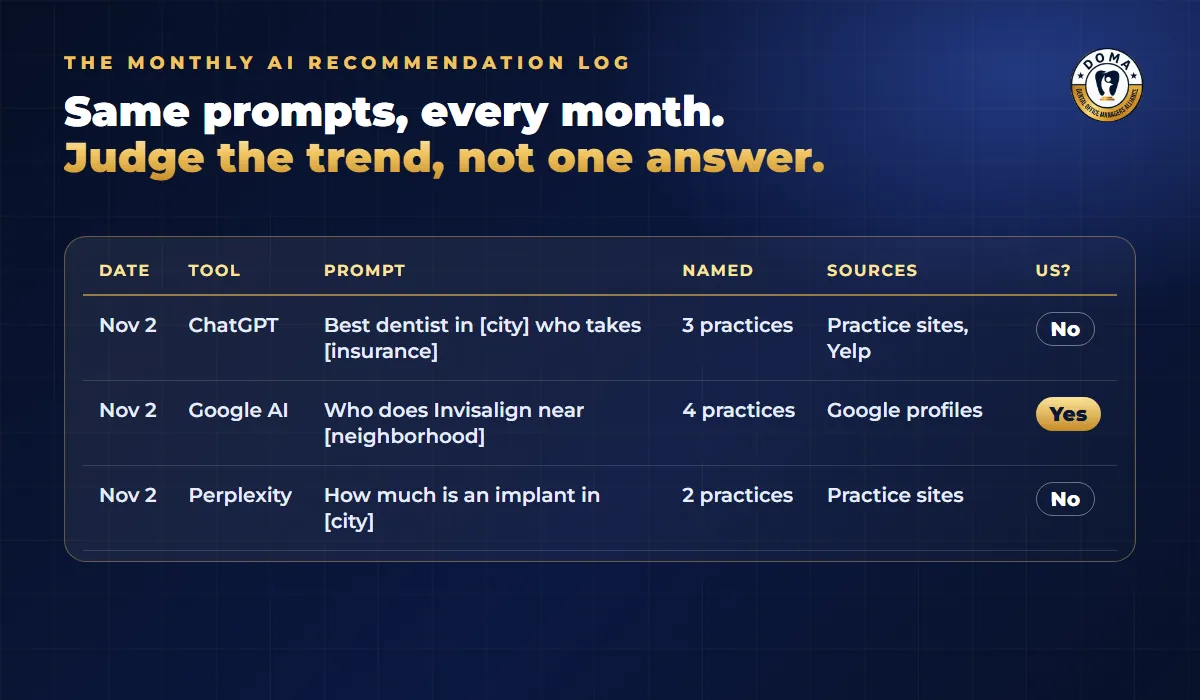
Expect the answers to change from one run to the next, even on the same day. One bad month means little. Look at the trend over a quarter, and check which sources keep getting cited. Those are the listings and pages worth fixing first.
Free guide
The Daily, Weekly, Monthly Task Calendar for Dental Teams
Give the monthly AI check a home next to the rest of your recurring work, with an owner and a day.
Get the free guideMyths and What Not to Buy
“You need special AI schema or an llms.txt file.” Google says there are no additional requirements to appear in AI Overviews or AI Mode, and no special optimization or AI text files are needed. Standard SEO practices still apply.
“Schema alone will get you in.” Structured data helps Google understand a page, but Google is explicit that the page must be indexed and eligible to appear with a snippet, and that inclusion isn’t guaranteed.
“Blocking Google-Extended hurts your Google rankings.” It doesn’t. Google-Extended controls whether your content is used for Gemini training and grounding, and it doesn’t affect your inclusion in Google Search.
“We guarantee ChatGPT will recommend you.” No one controls that. AI answers change from run to run. A vendor promising a spot in ChatGPT is promising something they can’t deliver.
“Buy reviews, or only ask happy patients.” Fake reviews are illegal under federal rules, and selective asking breaks Google’s policy. More on both below.
If you do talk to a vendor, the questions in how to evaluate AI tools before you buy anything and the marketing black box apply here too: what exactly will you do, how will we measure it, and who owns the accounts.
Compliance Guardrails for Reviews and Posts
HIPAA in Review Replies
Replying to a review can be a HIPAA violation if it confirms the person is a patient or reveals anything about their care. The HHS Office for Civil Rights has settled cases with dental practices over exactly this: New Vision Dental paid $23,000 in 2022, and Elite Dental Associates paid $10,000 in 2019 over disclosures in replies to patient reviews online.
A safe reply thanks the person, doesn’t confirm they’re a patient, doesn’t mention treatment, visits, insurance or billing, and invites them to call the office. Write a short reply policy, share it with whoever answers reviews, and have your compliance advisor look at it. This isn’t legal advice.
The FTC Rule on Reviews
The FTC Consumer Reviews and Testimonials Rule, in effect since October 21, 2024, prohibits fake reviews, including reviews from staff or family that don’t disclose the connection. It prohibits offering incentives in exchange for a positive (or negative) review, and it requires staff and other insiders to disclose their connection. It also covers suppressing negative reviews.
If you offer anything for a review, it can’t depend on what the review says, and you should check each platform’s own policy first. Many don’t allow incentives at all.
Patient Photos and Testimonials
Before-and-after photos, patient videos and testimonials on your website or social media need the patient’s written HIPAA authorization. Keep a signed form for every one.
The same care applies when you use AI tools for any of this. See PHI-safe AI prompting for dental office managers.
A 30-Day Plan for One Office Manager
Week 1: Write the official practice facts sheet. Fix your Google Business Profile against it.
Week 2: Search your practice name and phone number. Claim and correct Bing Places, Apple Business, Yelp, Healthgrades and your insurers’ directories.
Week 3: Start the review ask at checkout and write the review reply policy.
Week 4: Hand your web company the technical list and the patient questions for your two most important service pages. Run your first AI test and start the log.
After that, it’s maintenance: the log once a month, a listing sweep once a quarter, and two improved service pages a month.
This checklist is about how patients find you. For AI inside the office, start with the AI for dental office managers hub and the AI implementation guide.
AI Ready Certification
Using AI inside your office too?
AI Ready Certification covers AI in the office manager’s daily work: six self-paced modules and 36 practical lessons, with a verifiable badge and a 14-day promise.
See the certificationFAQ
How do I get my dental practice recommended by ChatGPT?
No one can guarantee it. What you can do is make your practice easy to find, verify and quote: one official version of your name, address, phone and hours everywhere, a complete Google Business Profile, steady reviews, and service pages that answer the questions patients actually ask. Then test monthly.
Where does ChatGPT get information about dental practices?
From what it finds on the web: practice websites, directories, review sites and other pages. In a Dental Economics study of 1,405 patient questions run through ChatGPT in mid-2026, practice-owned websites were 53.8% of the cited sources, the largest group. That study covered ChatGPT only, in the US.
Do I need special schema to appear in Google AI Overviews?
No. Google says there are no additional requirements to appear in AI Overviews or AI Mode, and no special schema or AI text file is needed. The page has to be indexed and eligible to show in Search with a snippet, and inclusion is not guaranteed.
Do reviews affect whether AI recommends a dental practice?
Reviews are one of the places these tools look, and practitioners who test AI answers treat steady, recent reviews as a baseline. No AI company publishes how much weight reviews get, so treat this as an observation, not a rule.
How do I check if AI search recommends my practice?
Pick five or six prompts your patients would use, run them every month in ChatGPT, Google, Gemini and Perplexity while logged out, and log the date, the practices named, the sources cited and whether you appeared. Answers change from run to run, so judge the trend over a quarter.
How can our office respond to online reviews without violating HIPAA?
Never confirm the reviewer is a patient and never mention treatment, visits, insurance or any detail from their record. Thank them, invite them to call the office, and keep it general. Check your reply policy with your compliance advisor.
Who should own AI search visibility in a dental office?
Mostly the office manager. Matching listings, the Google Business Profile, the review routine and the patient questions for service pages are operations work. The web company handles the technical items, and the dentist approves clinical content.
DOMA community
Ask the managers who are testing this right now
Compare notes with 26,700+ dental office managers in the Dental Office Managers Community. Start with the Free Starter Kit.
Join the communityFree for dental office managers
Get the Free Starter Kit
4 ebooks and 2 course previews from Kyle Summerford, plus free membership in the DOMA community of 26,700+ office managers. No credit card.