Why Dental Office Systems Break Down (Even When Everyone Knows What to Do)
If your dental office system only works because the Office Manager remembers to remind everyone, you don’t really have a system.
Most dental offices have plenty of things everyone knows should happen.
Insurance should be verified before the patient arrives. Balances should be collected. Clinical notes should be completed. Unscheduled treatment should be followed up on. Claims should go out with the correct attachments. Patients should leave with their next appointment scheduled.
Related: Operational Excellence: How to Build a Zero-Chaos Daily Workflow in Your Dental Office
None of this is a surprise.
And yet, Office Managers everywhere find themselves saying the same things:
“We’ve talked about this.”
“It’s in the SOP.”
“Everyone knows they’re supposed to do it.”
And maybe the most frustrating one:
“Why am I still reminding everyone?”
When a process repeatedly breaks down, it’s easy to assume we have an accountability problem, or even a people problem.
Sometimes we do.
But before addressing the person, it’s worth taking a closer look at the process.

Knowing What to Do Isn’t the Same as Having a System
A dental office SOP is important. It gives us consistency, provides a training resource and documents how something should be done.
But documenting a process doesn’t automatically make that process happen.
A sustainable system needs more:
EXPECTATION → OWNERSHIP → PROCESS → MEASUREMENT → FOLLOW-UP
When one of those pieces is missing, even good employees can struggle to consistently execute what everyone “knows” should happen.
So where do dental office systems commonly break down?
1. The Expectation Is Clear, but Ownership Isn’t
“The front desk handles insurance verification.”
Okay, but who specifically owns making sure tomorrow’s patients are verified?
“The team follows up on unscheduled treatment.”
Who?
When a responsibility belongs to everyone, it can very easily become owned by no one.
Shared work can absolutely be part of a good system, but there should still be clear ownership.
Managers should be able to answer:
Who is ultimately responsible for making sure this gets done?
And just as importantly, the employee should give you the same answer.
2. The Process Doesn’t Match the Reality of the Day
Sometimes a process looks great on paper but falls apart at 10:15 on a busy Tuesday.
The phones are ringing. Three patients arrived at once. Someone called out. The doctor needs something. A parent wants to discuss a bill. The hygienist is running behind.
Suddenly, that task everyone agreed was important moves to the bottom of the list.
That doesn’t necessarily mean the team doesn’t care.
Ask:
- Where does this process tend to break down?
- What competes with it?
- Does the employee realistically have the time, tools and information needed to complete it?
Sometimes the answer isn’t more accountability.
Sometimes the workflow needs to change.
3. We Trained It, but Never Reinforced It
Training someone once is not the same as creating a habit.
We explain the process. They watch someone do it. Maybe they practice it a few times.
Then we move on.
Weeks later, we discover that different employees are doing the same task three different ways, or it quietly stopped happening altogether.
Training needs a feedback loop:
Teach → Observe → Coach → Reinforce → Recheck
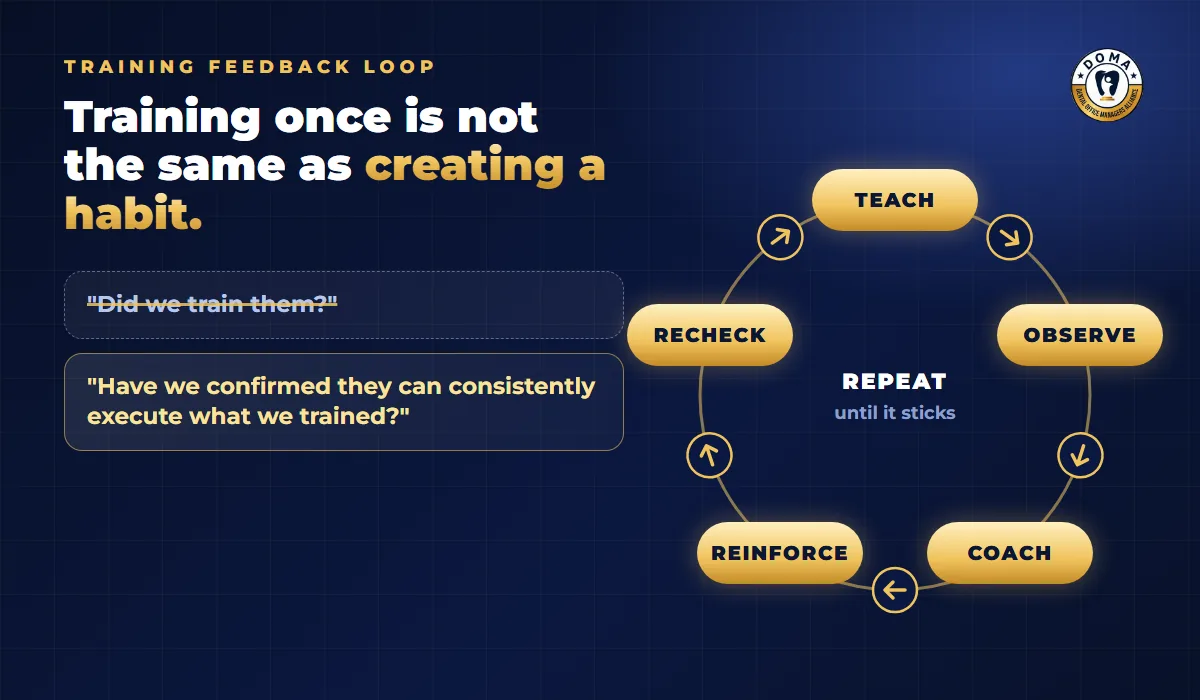
Instead of asking only, “Did we train them?” ask:
“Have we confirmed they can consistently execute what we trained?”
Those are two very different questions.
4. Nobody Is Measuring Whether It’s Actually Happening
One of the easiest ways for a system to quietly disappear is for nobody to look at the outcome.
If we say every unscheduled treatment patient should receive follow-up, how do we know it happened?
If balances should be collected at checkout, are we looking at the numbers?
If insurance verification should be completed ahead of time, is there a way to see what remains unfinished?
Measurement doesn’t always require another complicated report.
It might be a checklist, dashboard, audit, KPI or quick weekly review.

If something matters enough to create an expectation around it, there should be some way to know whether it’s happening.
5. The Office Manager Has Become the System
This may be the biggest warning sign of all.
The manager remembers.
The manager reminds.
The manager checks.
The manager catches what was missed.
The manager follows up.
The manager fixes it.
And eventually, without anyone intending for it to happen, the actual process becomes:
Wait for the Office Manager to tell us what needs to be done.
That creates two problems.
The team never develops true ownership.
And the manager becomes exhausted trying to carry an entire practice around in their head.
A good system should make the manager less necessary to the daily execution of the task, not more.
That doesn’t diminish the manager’s role. Instead of constantly reminding people what to do, the manager can spend more time leading, coaching, analyzing and improving the practice.
Free guide
Stop Being the Reminder System
A workbook to find what you keep reminding people about and hand the ownership back to the team.
Get the free guideBefore Addressing the Person, Run a Dental Office Systems Check
The next time you find yourself thinking:
“How many times do I have to tell them?”
Try running through a quick check first.
- EXPECTATION: Have we clearly defined what needs to happen and what “done correctly” looks like?
- OWNERSHIP: Does one person clearly understand what they own?
- PROCESS: Is the workflow realistic, and have we addressed barriers?
- MEASUREMENT: How will we know whether it’s happening consistently?
- FOLLOW-UP: When are we reviewing it, coaching it and addressing misses?
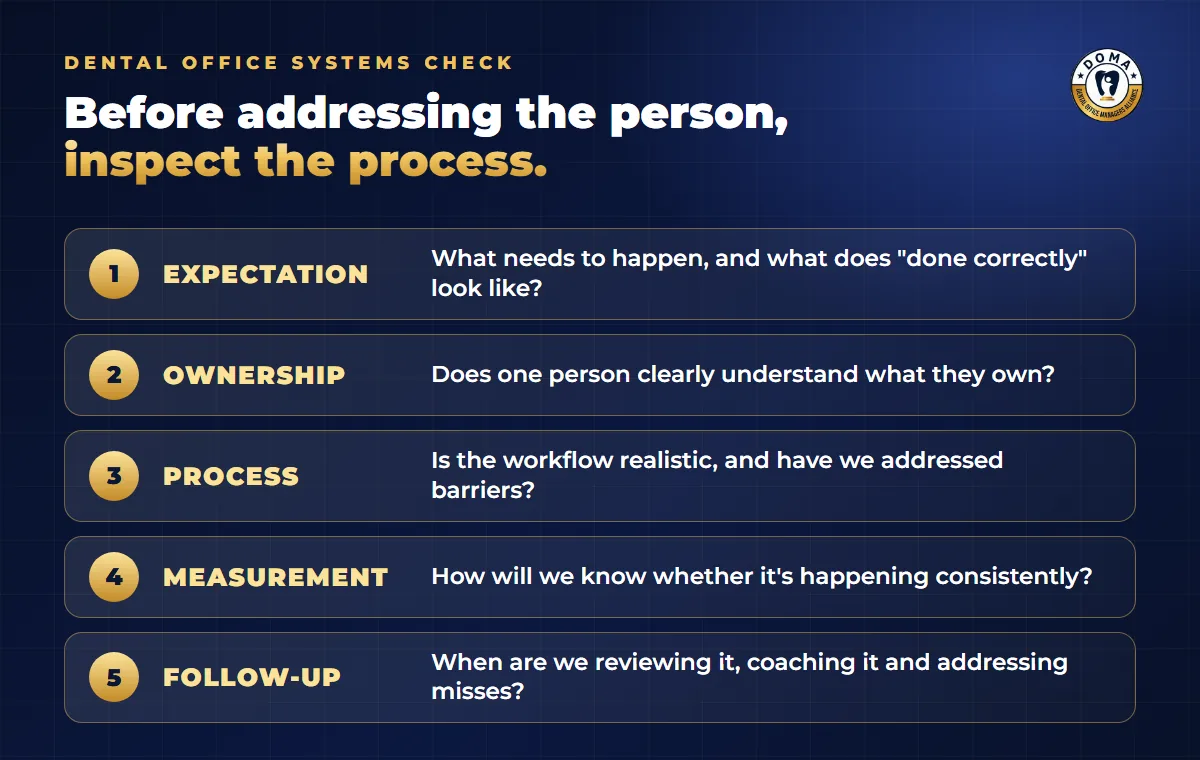
If those pieces aren’t in place, start there.
But there’s another side to this conversation that’s equally important.
Clear systems don’t eliminate accountability. They make fair accountability possible.
Once expectations are clear, ownership has been established, the employee has been properly trained, barriers have been addressed, results are being measured and consistent follow-up has occurred, continued failure to meet the expectation may no longer be a systems problem.
Related: Dental Office Manager Professional Development: What Managers Actually Need to Grow
Now you can have a very different conversation.
Not:
“Why can’t you ever remember to do this?”
But:
“We’ve clarified the expectation, made sure you have what you need and reviewed how success will be measured. We’re still not seeing it happen consistently. Let’s talk about what needs to change from here.”
That is accountability built on clarity, not frustration.
Free guide
The Accountability Reset
Turn one recurring office problem into a clear, measurable process: one owner, one definition of done, a Reset Conversation Planner and a four-week scorecard.
Get the free guideOne Final Question for Dental Office Managers
Look around your practice and ask yourself:
What process currently depends too heavily on me?
If you were out of the office for two weeks, would it continue to happen consistently?
Or would it stop because the person who really owns the system is you?
If it’s the latter, don’t immediately add another reminder to your calendar.
It might be time to build a better system. 🩷
Free guide
From SOP to Actually Done
Take one SOP through seven stages, from document to adjust, with a printable worksheet and a 30-day rollout.
Get the free guideFAQ
Why do dental office systems break down when everyone knows what to do?
Documenting a process doesn’t automatically make that process happen. A sustainable system needs expectation, ownership, process, measurement and follow-up. When one of those pieces is missing, even good employees can struggle to consistently execute what everyone knows should happen.
Related: Two-Way Radio Communication for Dental Offices
Where do dental office systems most often break down?
In five common places: unclear ownership, a process that doesn’t match a busy day, training that was never reinforced, no measurement, and an office manager who has become the system.
Is it a people problem or a systems problem?
Check the system first. Is the expectation clear, does one person own it, was the employee trained, were barriers addressed, and is someone measuring and following up? If all of that is in place and it still isn’t happening, it may no longer be a systems problem.
How do I know if I’ve become the system in my dental office?
If you remember, remind, check, catch what was missed, follow up and fix it, the process has become waiting for the Office Manager. Ask whether the task would continue consistently if you were out of the office for two weeks.
DOMA community
You’re not the only one carrying the reminders
Join 26,700+ dental office managers in the DOMA community. Membership starts free, and DOMA Elite adds the Resource Vault of forms, SOPs and scripts.
See membership plansFree for dental office managers
Get the Free Starter Kit
4 ebooks and 2 course previews from Kyle Summerford, plus free membership in the DOMA community of 26,700+ office managers. No credit card.