
The Weekly Dental Office Scorecard: 6 to 8 Numbers, One Page, Every Monday
A one-page weekly dental office scorecard: six to eight numbers, a target and an owner for each, and a short Monday review.

The short answer: A dental office scorecard is one page with six to eight numbers your team reviews every week. Each number has a weekly target and one owner. It sits between the daily huddle and the monthly report review, so you catch a slipping number in days instead of finding it at month-end.
Here’s a simple test.
Free guide
The Accountability Reset
Name one owner, write down what done looks like and track it for four weeks. Free guide.
Get the free guideIt’s Monday morning. Ask your team whether last week was a good week.
If the answer is “it felt busy,” you don’t have a scorecard.
Your practice software has dozens of reports. Your dashboard probably shows more tiles than anyone reads. The problem is that nobody agreed on which few numbers matter, what “good” looks like for each one, and whose job it is to watch it.
That’s a system gap. Here’s how to close it.
Scorecard vs. Dashboard vs. Monthly Reports
Think of it as three layers.
- Daily huddle: today. What’s on the schedule, where the openings are, what treatment is waiting. DOMA’s morning huddle report form covers this layer, and so does how to run morning huddles that actually energize your team.
- Weekly scorecard: last week. Six to eight numbers, red or green, with an owner each.
- Monthly reports: the full picture. The 10 reports every dental practice should run monthly is that list.
A dashboard is different from all three. It’s a screen that shows you everything at once. Useful for digging. Easy to ignore. A scorecard is a decision about what matters this week, written down, with names next to it.
If you want the formulas and benchmarks behind each number, they’re in dental practice KPIs: formulas, benchmarks and owners.
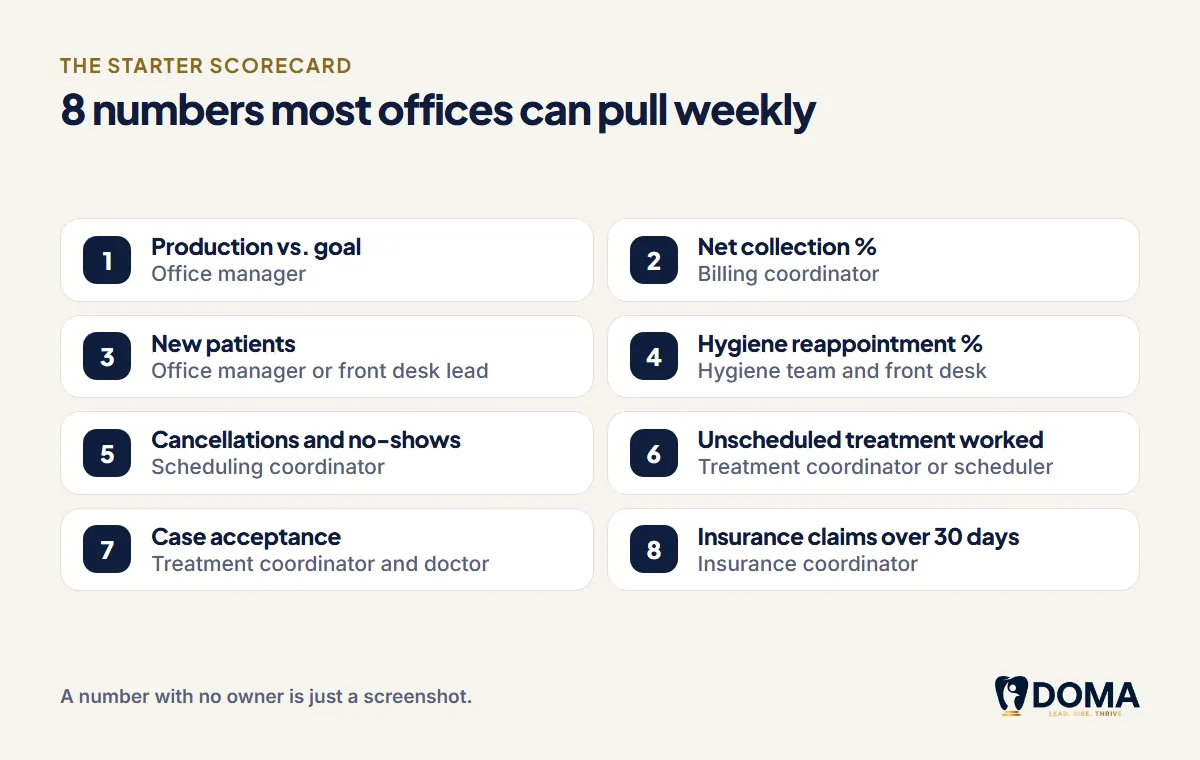
The Starter Scorecard: 8 Numbers Most Offices Can Pull Weekly
You don’t need all eight on day one. But most offices can pull every one of these from the software they already have.
| Metric | Where it comes from | Weekly target | Owner | Red flag |
|---|---|---|---|---|
| Production vs. goal | Production report, by provider | Your weekly goal (daily goal × days worked) | Office manager | Below goal two weeks in a row |
| Net collection % | Production and collections reports | Your target. ADA benchmark is 98% of adjusted production | Billing coordinator | Rolling 4-week number trending down |
| New patients | New patient report | Set from your own last 12 weeks | Office manager or front desk lead | Below your 12-week average |
| Hygiene reappointment % | Recare or hygiene report | ADA benchmark: 90% of recare patients scheduled | Hygiene team and front desk | Below 90% |
| Cancellations and no-shows | Appointment or broken appointment report | ADA benchmark: 5% or less | Scheduling coordinator | Above 5% |
| Unscheduled treatment worked | Unscheduled treatment list, plus call log | Calls or contacts per week, set by you | Treatment coordinator or scheduler | Calls not made |
| Case acceptance | Treatment plan or case acceptance report | ADA benchmark: at least 75% to 80% of presentations | Treatment coordinator and doctor | Below your trailing average |
| Insurance claims over 30 days | Outstanding claims or insurance aging report | Set from your own last 12 weeks | Insurance coordinator | Count or dollars rising week over week |
All ADA benchmarks are from the American Dental Association’s Key Performance Indicators page. Where the ADA doesn’t publish a number, the target comes from your own last 12 weeks.
Two practical notes.
Collections bounce week to week. Insurance payments don’t land on a schedule. Look at a rolling four-week number so you’re not reacting to noise.
Pick your definitions once. Same-day cancellations only, or all cancellations? Case acceptance by count, or by dollars? Write it at the bottom of the scorecard and don’t change it.
How to Set Targets Without Guessing
Don’t make up a number because it sounds ambitious. And don’t copy a number from a vendor’s blog and call it a standard.
Here’s the method:
- Pull your last 12 weeks for each metric. That’s your baseline.
- Use the average as your starting target. The first goal is to stop sliding.
- Where the ADA has a benchmark, use it as the line you’re working toward. 98% collections, 90% of recare patients scheduled, 5% or less cancellations and no-shows, 75% to 80% case acceptance. If you’re already past it, the ADA line is your floor or ceiling, and your own trend is the target.
- Revisit targets quarterly, not weekly. Moving the goalposts every Monday tells the team the targets don’t mean anything.
Your scorecard should be honest about where you are. That’s the only way it helps you get somewhere else.
Give Every Number an Owner
A number with no owner is just a screenshot.
Ownership means one person is watching that number, knows what’s underneath it, and comes to the review ready to explain it. Here’s a starting split by role:
- Front desk / scheduling: cancellations and no-shows, new patients scheduled.
- Hygiene: reappointment percentage, shared with whoever checks patients out.
- Treatment coordinator: case acceptance, unscheduled treatment worked.
- Billing / insurance: net collection percentage, claims over 30 days.
- Doctor: production against goal, alongside the office manager. Case acceptance is shared with the treatment coordinator.
- Office manager: the scorecard itself. Making sure it’s filled in, reviewed, and acted on.
In a small office, one person might own three lines. That’s fine. What’s not fine is a line with no name.
When a red turns into an action, write it the same way every time: owner, task, done by when. “Scheduling coordinator: confirm tomorrow’s open hygiene slots, done by 3:00.” No “we should probably.” A name and a time.
This ties directly into DOMA’s team accountability system. Clear ownership makes accountability easier, because nobody is guessing what they’re responsible for. For hygiene and provider numbers specifically, use the weekly hygiene tracker and the guide to tracking weekly provider production.
Free guide
The Accountability Reset
Name one owner, write down what done looks like and track it for four weeks. Free guide.
Get the free guideRunning the Weekly Scorecard Review
Keep it short and keep it the same.
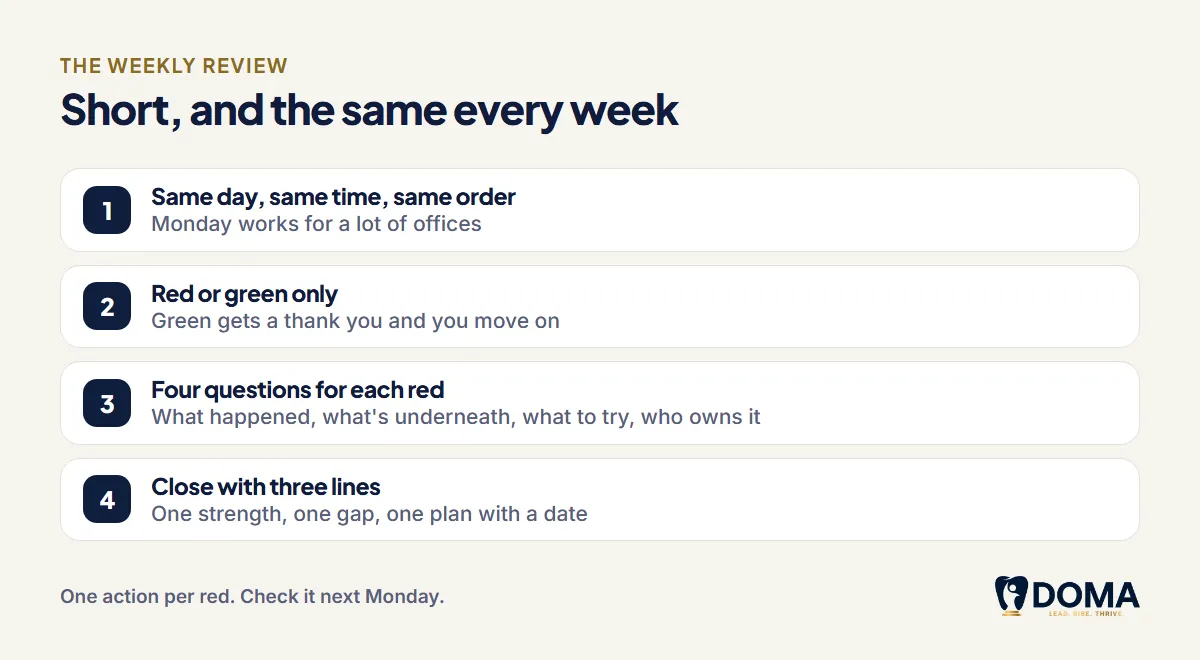
Same day, same time. Monday works for a lot of offices because it’s a fresh week. Pick one and protect it.
Same order every week. Go down the scorecard top to bottom. No skipping around.
Red or green only. Don’t debate a number that’s on target. Green gets a “thank you” and you move on.
Talk about the reds. For each red, the owner answers four questions:
- What happened?
- What sits underneath it?
- What’s one thing we’ll try this week?
- Who owns that, and when do we check?
That second question comes from Juli Temple’s framework in the number behind the number. A red number is a clue, not a diagnosis.
One action per red. Not five. One. Then check it next Monday.
Close with three lines. One strength: what’s working. One gap: the red that matters most. One plan: what you’ll do about it over the next two weeks, with an owner and a date.
When a number stays red for a few weeks, have the one-on-one, and keep it about behavior and impact, not personality. Here’s the phrasing I use:
“On [date], [behavior], and the impact was [impact]. Next step: [task] by [date].”
Then book the follow-up before you leave the room: “Next check-in [date/time]. Recap: [who/what/when].”
If someone gets punished for bringing a red number, they’ll stop bringing red numbers. Then you have a scorecard that’s always green and a practice that isn’t.
Free guide
Production Is Down: But Why?
A free root-cause guide for the week a number drops and nobody knows why.
Get the free guideScore the Work Behind the Numbers
The eight numbers tell you what happened. They don’t tell you how the conversations behind them went. A no-show rate is partly a huddle problem. Case acceptance is partly an insurance-conversation problem.
So once the number scorecard is a habit, add a second kind: a short list of steps for the conversations that drive those numbers. Check each step after the conversation, and coach the ones that get skipped.
Four conversations are worth scoring first:
- The morning huddle: today’s goal and peak times, at least two risks, an owner and a time for each fix, and a recap. This feeds no-shows and production against goal.
- The insurance conversation: coverage confirmed, benefits in plain language, a dollar estimate (“estimate, not guarantee”), at least two ways to pay, and the next step booked. This feeds case acceptance and collections.
- The performance review: wins, gaps, one to three goals, a plan, and a follow-up date. This is how a red number becomes a coaching plan.
- The job interview: real past examples, the requirements and realities of the role, values fit, and clear next steps.
Each one also gets red flags, written as yes-or-no checks: no daily goal stated in the huddle, no dollar estimate given in the insurance conversation, no follow-up booked after a review. If a red flag fires, that step needs coaching.
Spreadsheet or Software Dashboard?
Start with a spreadsheet.
Most practice management systems and analytics tools can show you these numbers automatically, and once the habit exists, that saves real time.
But a dashboard doesn’t build the habit for you. If your team isn’t reviewing eight numbers on a sheet every Monday, they won’t review them on a screen either. A dashboard nobody reads is no different from a report nobody runs.
So: spreadsheet first. Fill it in by hand for a few months. Once the review is a habit, move it into your software’s dashboard if that’s easier. At that point, a good dashboard earns its place with four things: trends over time, filters by person and date range, the ability to click a number and see what’s underneath it, and a clean export for your doctor meeting.
Where AI helps: modern tools can pull these numbers and flag the reds before the meeting. Where it doesn’t: deciding what to do about a red, or having the conversation with the person who owns it. That’s still the manager’s job. More on that in how AI is transforming team performance tracking. If you use a general AI tool with your numbers, keep patient information out of it.
Common Scorecard Mistakes
Too many metrics. If it doesn’t fit on one page, it isn’t a scorecard. Start with six. Add later.
No owner. A number everybody watches is a number nobody watches.
Monthly only. By the time a monthly report shows the no-show spike, you’ve lived with it for four weeks.
Changing the definitions. If case acceptance was by count last month and dollars this month, you don’t have a trend.
Punishing the messenger. Covered above. It kills the whole system.
No follow-up booked. An action with no check-in date is a wish.
Fixing everything at once. Don’t announce ten changes. Pick the red that matters most and fix it completely.
Frequently Asked Questions
What is a dental office KPI scorecard?
A dental office KPI scorecard is a one-page list of six to eight key numbers, each with a weekly target and one named owner, reviewed by the team on the same day every week. It sits between the daily huddle and the monthly report review, so problems surface in days instead of at month-end.
How many metrics should a dental scorecard track?
Six to eight is a workable range for most offices. Fewer than that and you’ll miss early warnings. More than that and the review turns into a report reading. Start with six numbers the team can actually influence, give each an owner, and add more only after the weekly review is a habit.
What is the difference between a dental practice dashboard and a scorecard?
A dashboard shows many numbers at once, usually inside your practice software or an analytics tool, and it’s built for exploring. A scorecard is a short, fixed list of numbers, each with a target and an owner, reviewed on a set schedule. The dashboard shows everything. The scorecard tells the team what matters.
Which dental KPIs should be reviewed weekly?
Review the numbers that can change fast and that the team can act on within a week: production against goal, hygiene reappointment, cancellations and no-shows, unscheduled treatment worked, new patients, case acceptance, collections on a rolling four weeks, and insurance claims over 30 days. Save overhead and annual growth for monthly or quarterly.
Who should own the numbers on a dental office scorecard?
The person closest to the work. Scheduling owns cancellations and no-shows, hygiene shares reappointment with the front desk, the treatment coordinator owns case acceptance and unscheduled treatment, and billing owns collections and claims. The office manager owns the scorecard itself: making sure it’s filled in, reviewed, and acted on every week.
Start This Monday
You need one page, six to eight numbers, a target for each, and a name next to every line.
Fill it in this Monday. Review it next Monday. Talk about the reds.
That’s where I’d start.
Use the starter scorecard. The table above is your starter scorecard. Copy it into a spreadsheet and fill in your targets.
Want forms, SOPs, and scripts ready to use? DOMA Elite members get the Resource Vault of forms, SOPs, and scripts.
Show us yours. Share a screenshot of your scorecard, numbers blurred, in the Dental Office Managers Community. There are 27,000+ dental office managers in our network, and seeing how another office lays it out is half the battle.
The AI Ready Certification from The Dental AI Standard gives dental office managers the credential and the framework to bring AI into their practice with confidence. It’s $297 for 6 self-paced modules and 36 lessons, and it comes with a 14-day promise. And if you’re not already part of the largest community of dental office managers in the country, join DOMA today.
Free guide
The 10 Reports Every Dental Practice Should Run Every Month
The monthly side of your numbers on one page. Free checklist.
Get the free guideDOMA community
Show us your scorecard
Share a screenshot with the numbers blurred in the Dental Office Managers Community, 27,000+ office managers strong.
Join the communityFree for dental office managers
Get the Free Starter Kit
4 ebooks and 2 course previews from Kyle Summerford, plus free membership and a combined DOMA audience of 50,000+ dental professionals. No credit card.


